What Are AI Decision Models? Microsoft Decision-1 vs. Cloudflare Clef-Omni
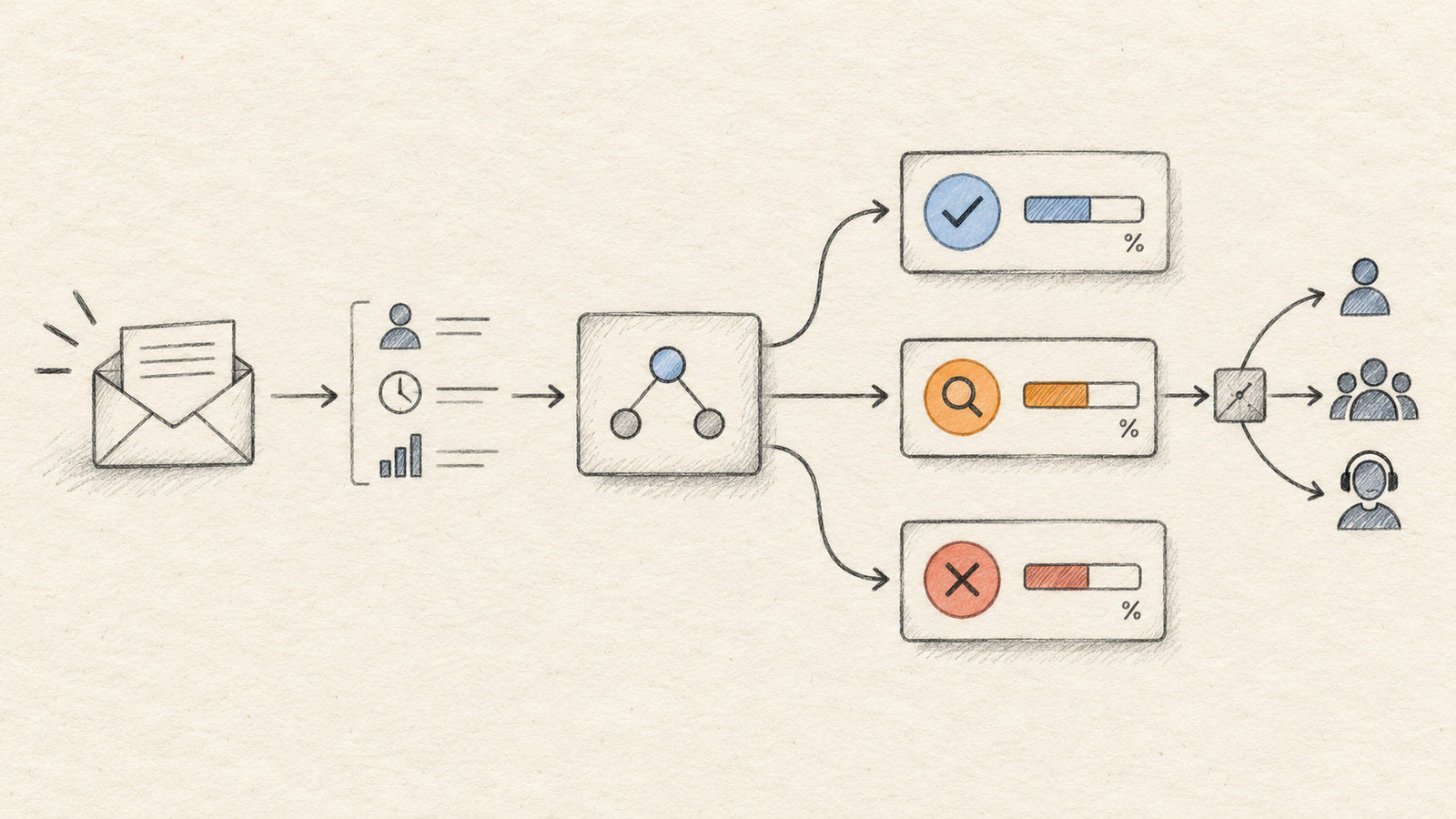
A decision model is an AI model that answers a question by choosing from a defined set of outcomes. Instead of writing a paragraph, it might return “billing,” “technical,” or “account,” together with a probability for each option.
That difference matters when a program must take the next step automatically. A customer-support router, content filter, or agent supervisor needs a compact answer that code can inspect. A conversational model can do this too, but it is asked to generate language first and only later fit that language into a schema.
This guide explains the decision-model pattern, then compares Microsoft Decision-1 with Cloudflare Clef-Omni. It also shows a practical way to try both through Decisions API.
1. A decision model returns a choice, not a conversation
Imagine a parcel desk receiving a damaged-item report. The clerk does not need an essay about customer service. The clerk needs one of three actions: refund, replace, or ask a person to review the case. The available actions are defined before the decision is made.
A decision model follows that structure. An application supplies a state—the message, record, image, or conversation to inspect—and one or more typed questions. A question can request a choice from named options, a score on an ordered scale, or a yes/no result. The model returns a structured answer and a probability distribution over the allowed choices.
The developer controls the decision vocabulary. Include “other” or “needs review” so the model has a safe fallback instead of inventing an action. Probabilities are not guarantees; test the model, set thresholds, monitor errors, and route uncertain or high-impact cases to a person.
2. Microsoft Decision-1: a text-focused specialist
Microsoft describes Decision-1 as a fast, single-pass model for structured decisions. Its model card says it was built and post-trained from Qwen3.5-9B, accepts text input, and supports tasks such as classification, routing, scoring, guardrails, and agent-action evaluation. Its listed context window is 32K tokens. See the Microsoft model catalog.
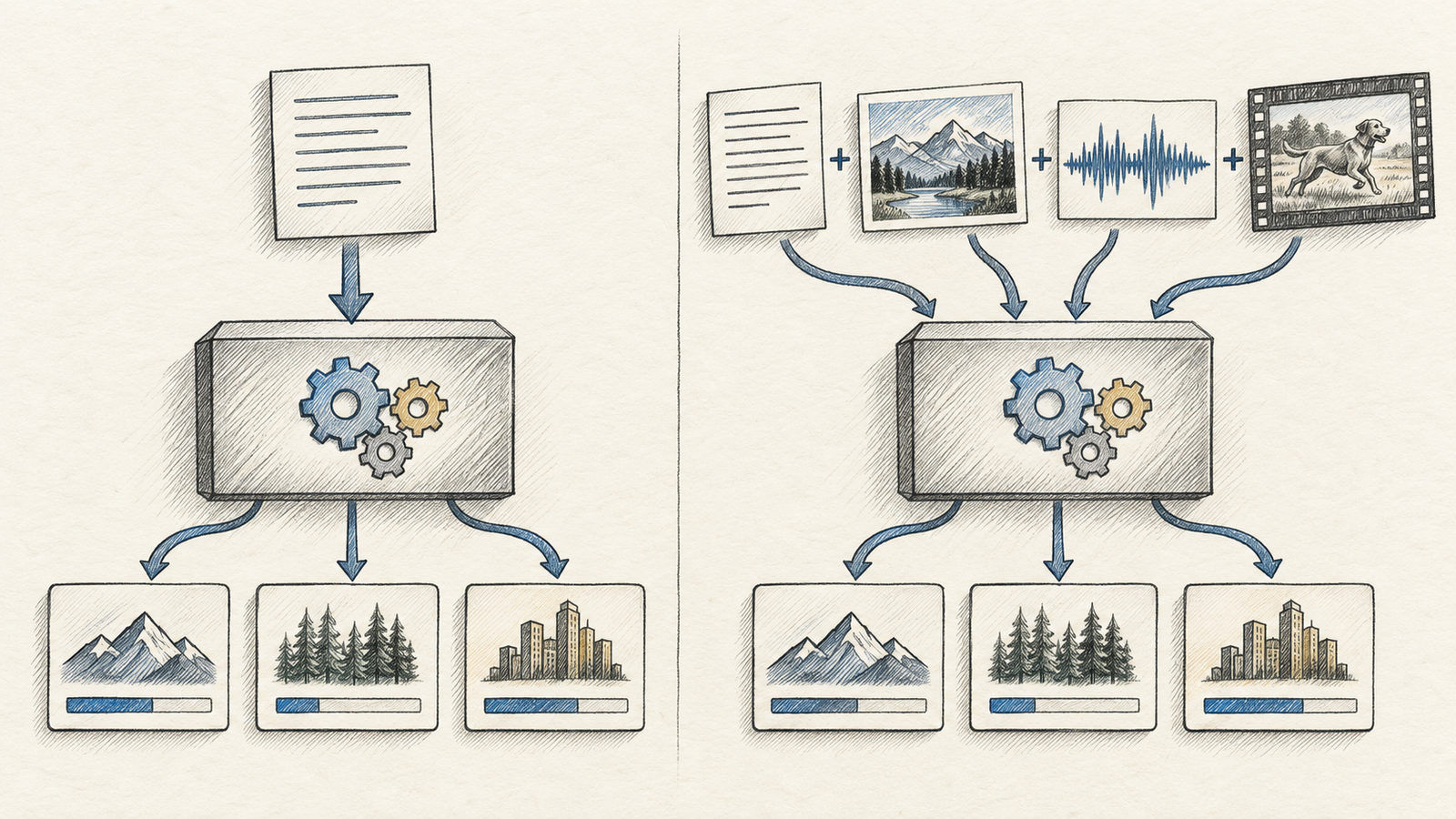
This profile is a good fit when the evidence is already text or JSON: a ticket, an account record, an extracted document, or an agent’s proposed action. The application defines the permitted answers, then asks the model to select and score them. If the source is an image or a recording, another component must first convert it to usable text, unless the workflow uses a different multimodal model.
Decision-1 is not a general-purpose chatbot. It is not meant to draft a long response to a customer or replace business rules that must be exact. Use code for deterministic checks such as account status, access control, or hard policy limits. Use the model where context and judgment are useful, and preserve the final gate for consequential actions.
3. Cloudflare Clef-Omni: decisions across media
Clef-Omni is Cloudflare’s multimodal member of the Clef decision-model family. The official Workers AI documentation describes a 30-billion-parameter mixture-of-experts model with about 3 billion active parameters. It accepts text, JSON, images, audio, and video, then returns probabilities for the choices in a typed question.
That media support changes the shape of an application. A moderation service could evaluate a clip with its soundtrack, or a visual quality check could inspect an image without a separate OCR or captioning step. The model still needs a clear question and allowed outcomes. “Is this upload safe for this audience?” with policy-specific options is more useful than “What do you think?”
Cloudflare’s announcement describes the model and its unified decision interface. Multimodal input does not make the result self-explanatory: teams should test edge cases such as unclear audio, off-screen context, unusual languages, and contradictory signals. Check current provider limits and account access before planning a production workload.
4. How to compare the two
The main distinction is the input boundary:
- Choose Decision-1 for text or structured records.
- Try Clef-Omni when images, audio, or video matter.
- Compare both on the same labeled examples when they can accept the same input.
Keep question IDs stable, define every option, and include a fallback. Measure results by category; one average score can hide costly failures on rare cases.
A useful comparison separates three questions: Does the model choose the right option? Are its probabilities meaningful enough to support a threshold? Does the result arrive quickly and consistently enough for the application? Measure each on labeled examples. For rare but costly mistakes, report per-class precision and recall, not only overall accuracy. Keep a fixed evaluation set so prompt or model changes can be compared fairly.
5. Try them in Decisions API
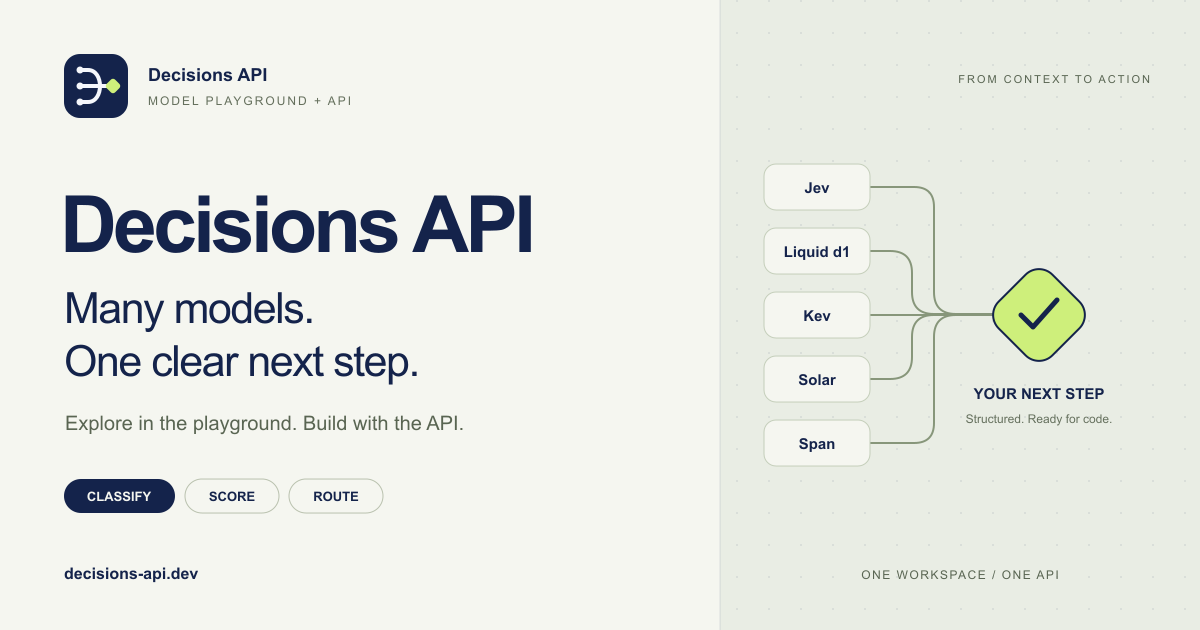
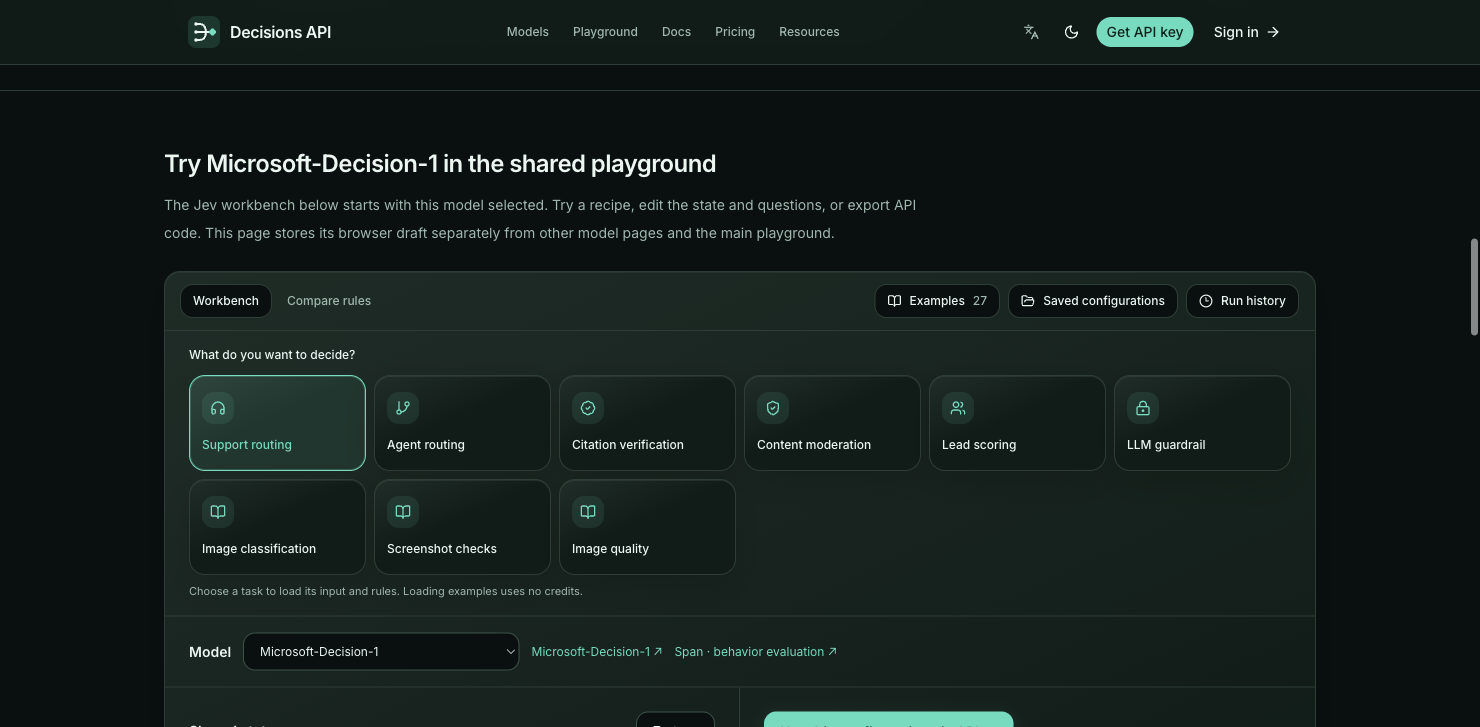
A useful starting point is Decisions API, which exposes Microsoft Decision-1 and Clef-Omni through a shared playground and API. Load a prepared task, edit its question rules, compare models, and export the request shape. Loading examples uses no credits, but running a request does; check current pricing and access first.
A simple workflow is:
- Open the Microsoft Decision-1 page or Clef-Omni page.
- Choose a task such as support routing, load an example, and inspect the state plus the allowed answers.
- Change the model or question rules, then compare it against the same examples. Keep a review option for ambiguous cases.
- When the schema is stable, create an API key and copy the generated server-side request into your application.
The API call has the following shape. The exact model ID and question schema are shown in the current product page:
const response = await fetch("https://decisions-api.dev/v1/systemone", {
  method: "POST",
  headers: {
    "Authorization": `Bearer ${process.env.DECISIONS_API_KEY}`,
    "Content-Type": "application/json"
  },
  body: JSON.stringify({
    model: "microsoft/microsoft-decision-1",
    state: "I was charged twice for order A-4471.",
    questions: {
      route: {
        type: "choice",
        instructions: "Choose the team that should review this case.",
        criteria: {
          billing: "Payments, charges, and refunds",
          technical: "Product errors",
          other: "No listed team fits"
        }
      }
    }
  })
});
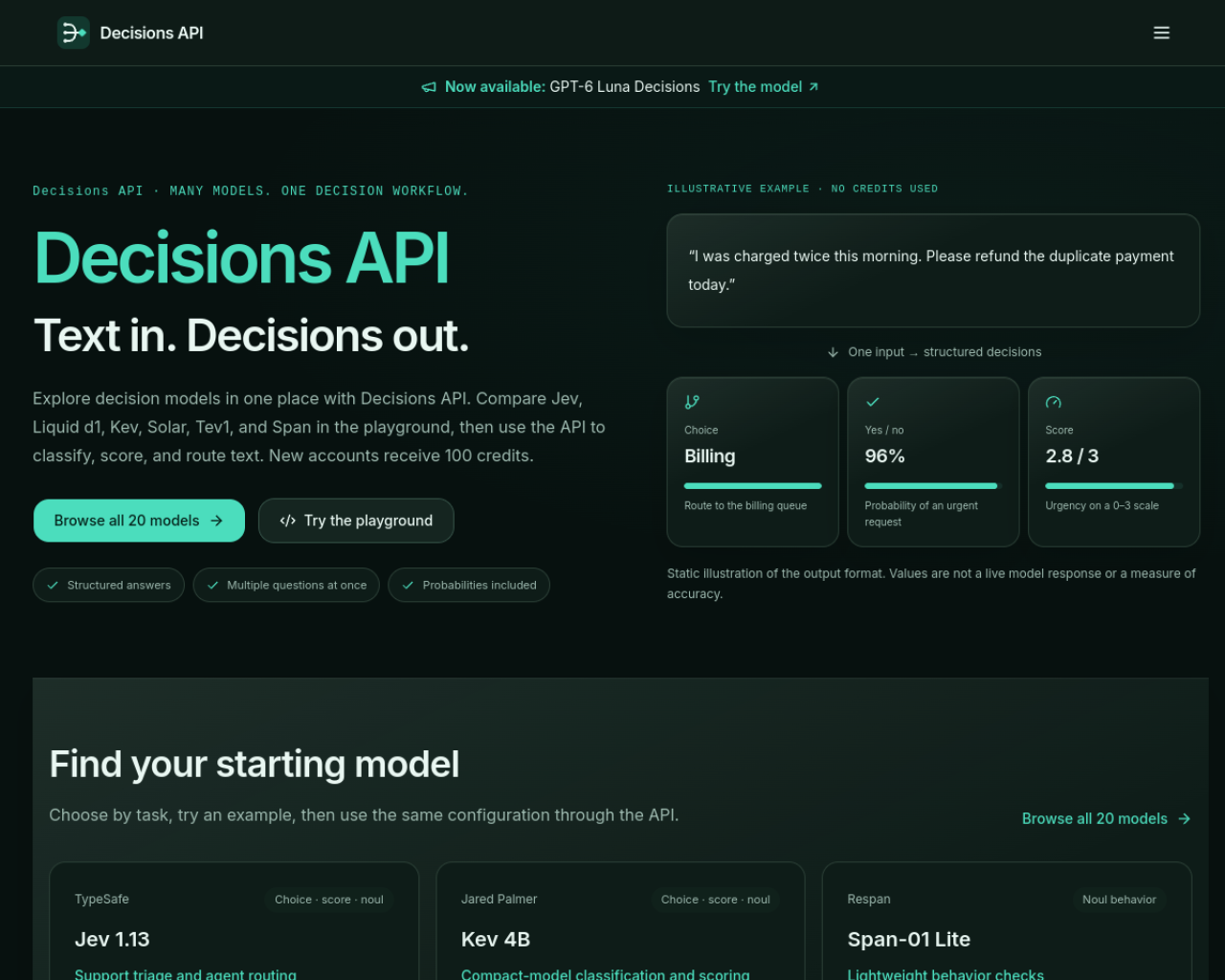
Keep the key on your server, validate responses, and compare them with human labels before triggering actions. The homepage’s sample output is a static illustration, not a live result.
6. When this pattern is useful
Decision models fit when unstructured input must become a limited action: route a ticket, triage an alert, score a lead, or review an agent step. They add less value when output must be open-ended prose or a fixed rule already decides the matter.
A hybrid design is often safer: deterministic code removes impossible actions, the model ranks the rest, and a confidence threshold sends uncertain cases to a person.
Microsoft Decision-1 and Clef-Omni share that decision-first idea, but they serve different input needs. Start with the simplest model that can read the evidence, build a small evaluation set, and let measured task performance—not the model’s name—decide what goes into production.