Tencent Youtu-Parsing-Omni: One Model for Documents, Charts, Audio and Video
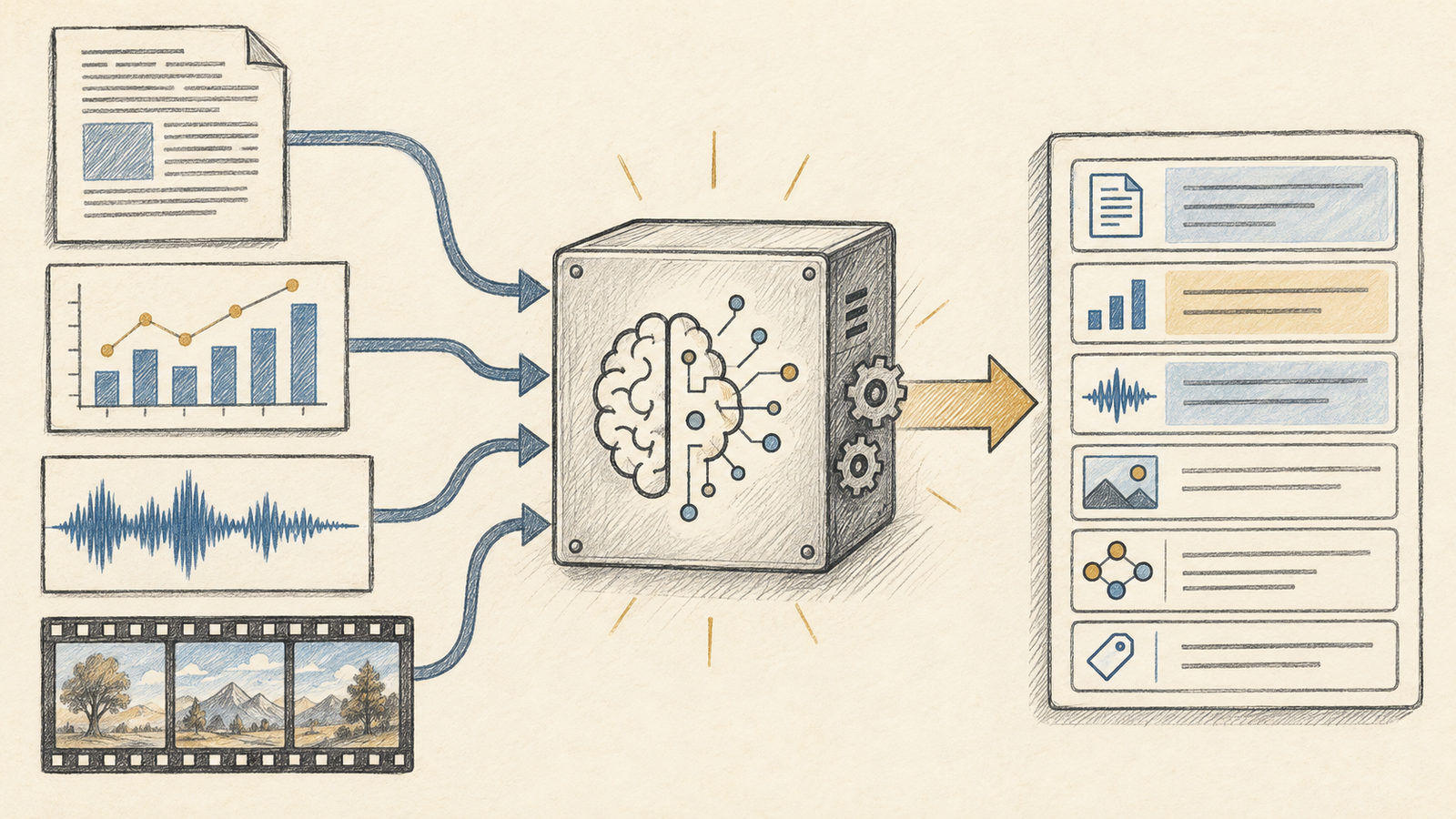
A PDF is not just a bag of words. Its meaning may depend on where a title sits, which values belong to a table, or how a diagram connects two labels. Audio and video add another layer: words, events, and timestamps must stay attached to the part of the recording they describe.
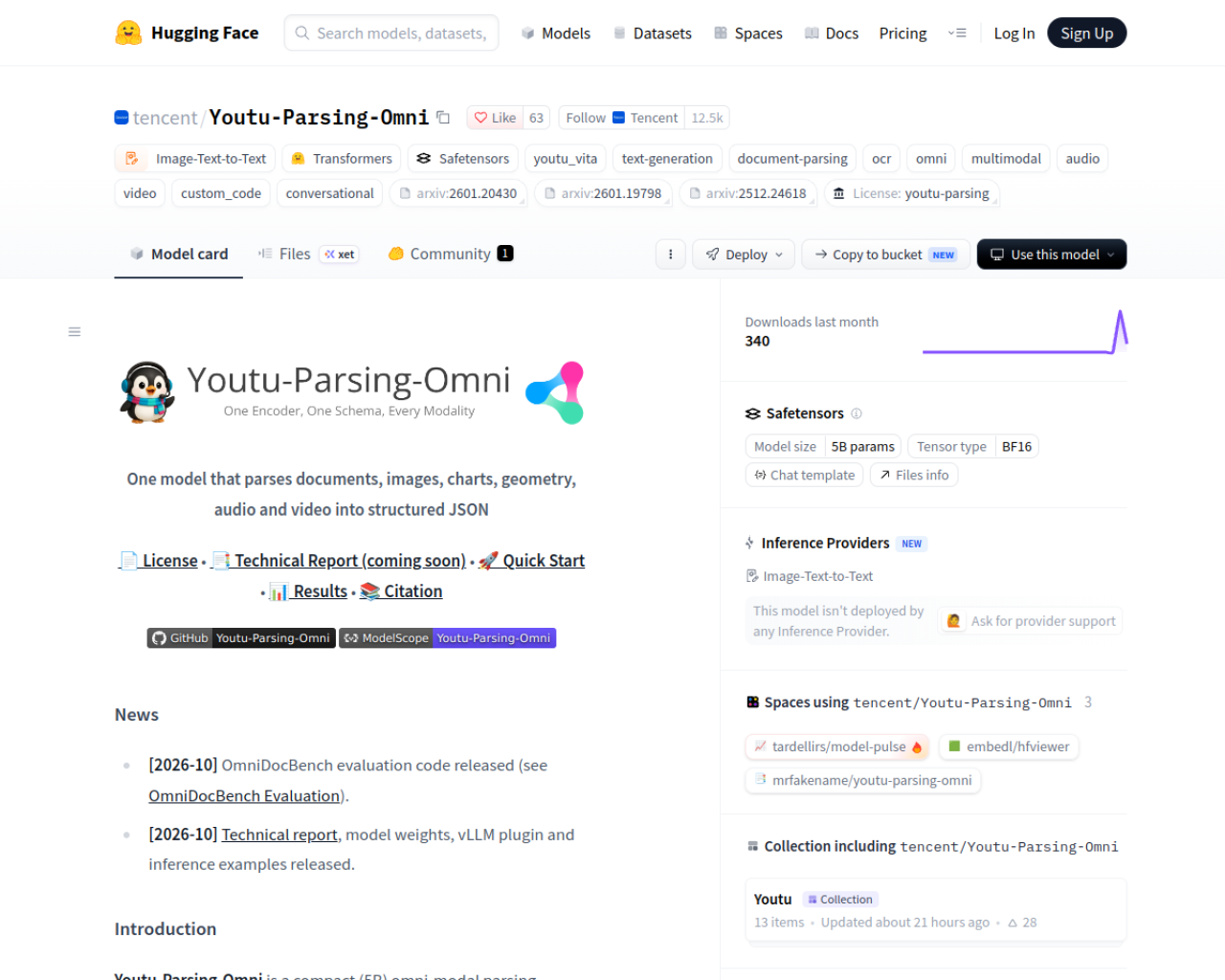
Tencent’s Youtu-Parsing-Omni is a compact multimodal parsing model designed to turn several kinds of media into structured information. Its public model card describes a five-billion-parameter model that handles document pages, images, charts, diagrams, audio, and audio-visual video.
This article explains the problem it targets, how its outputs differ from ordinary OCR, and what developers should check before putting a research checkpoint into an application.
1. OCR reads characters; parsing recovers structure
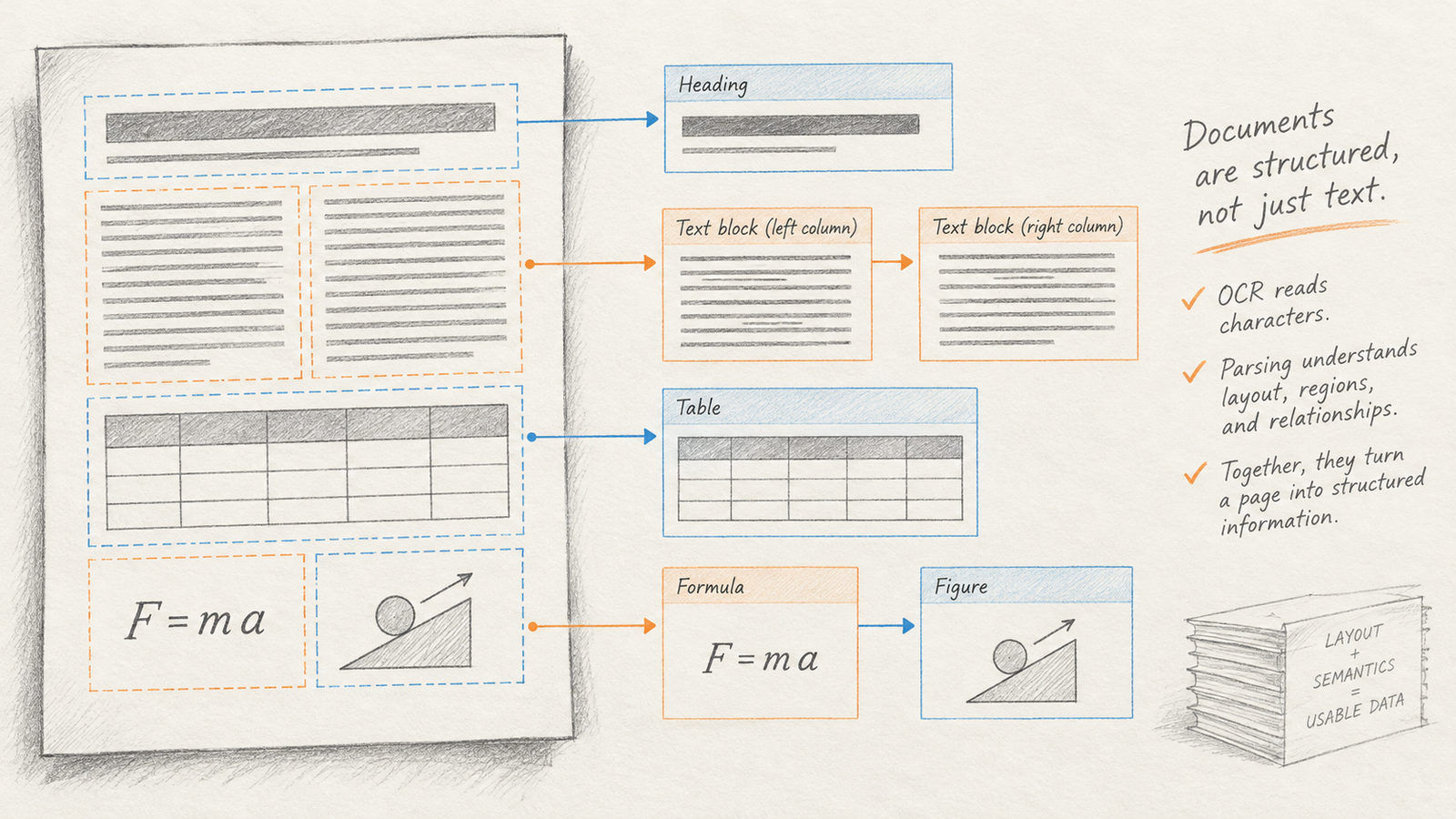
OCR answers a narrow question: which characters appear in this image? That is useful, but a character sequence does not tell an application whether a line is a heading, a table cell, a footnote, or a label attached to a chart.
Document parsing adds layout and relationships. A parser can identify text blocks, tables, formulas, figures, bounding boxes, and reading order. For an invoice, the difference is practical: the words “Total” and “$84.00” are only useful if the system can connect them as a field and value.
Youtu-Parsing-Omni extends this idea beyond static pages. Its model card describes outputs for OCR and layout, tables and formulas, as well as speech recognition, audio events, timestamps, and captions or narratives for video. Instead of building separate recognizers for every media type, a developer can explore one model family and one structured-output style.
2. What the public model card describes
The Tencent Youtu-Parsing-Omni model card describes the model as a compact omni-modal parsing system with roughly five billion parameters. It accepts document pages, general images, charts, diagrams, geometry, audio, and audio-video clips. Its outputs are described as structured JSON-like records rather than free-form chat.
The phrase “one model” should not be mistaken for “one universal answer.” Each input type still requires a specific task and an output contract. A chart parser may need to return series and axes. A meeting clip may need speech segments with timestamps. A scanned page may need bounding boxes and reading order.
The model’s practical value depends on whether the returned structure is stable enough for downstream code. Developers should inspect the official model card for supported tasks, examples, weight format, hardware guidance, dependencies, and license. Do not assume every input format in the description is available through a hosted endpoint; the public checkpoint may require you to set up inference yourself.
3. Where structured multimodal parsing helps
The model category is useful when an application needs to convert messy evidence into data:
- Document workflows: extract sections, tables, formulas, and coordinates from reports.
- Chart understanding: identify labels, legends, and the values represented by visual marks.
- Media search: create timestamped speech or event descriptions for audio and video.
- Accessibility: produce structured descriptions that can be indexed or passed to another system.
- Review pipelines: route uncertain pages or clips to a person with the relevant region highlighted.
For example, an analyst could process an earnings-report page, extract the table and nearby heading, then verify that the values match the correct quarter. A video archive could index a spoken phrase together with the time at which it appears. In both cases, structure makes the result easier to inspect and correct.
4. A sensible integration pattern
A robust application should keep the parser behind a small adapter. The adapter validates the media, chooses a task, sends the input, normalizes the model’s output, and checks that required fields exist before passing data onward.
A conceptual output might look like this:
{
  "source": "page-12",
  "elements": [
    {
      "type": "table",
      "region": [0.08, 0.31, 0.92, 0.72],
      "rows": []
    }
  ]
}
This is an illustrative schema, not a quoted response from Youtu-Parsing-Omni. The implementation should follow the model’s real output contract. Preserve source coordinates or timestamps so that a reviewer can compare extracted data with the original media.
For high-stakes extraction, add checks after parsing. Reconcile totals, validate dates, ensure table columns have the expected shape, and flag missing or low-confidence fields. A multimodal parser can make data available; it cannot decide that the source itself is trustworthy.
5. What to test before deployment
Start with a representative validation set. Include clean scans and noisy photos, single- and multi-column pages, handwritten annotations if relevant, charts with small labels, background speech, overlapping voices, and short as well as long clips. Keep separate scores for each task; success on page OCR does not imply success on video timestamps.
Measure more than exact text accuracy. For a document system, check whether a value was attached to the correct label and whether the bounding box points to the right region. For audio and video, check timestamp alignment and whether the description invents events that are not present.
Also measure operational cost. Five billion parameters is relatively compact compared with many multimodal models, but inference still needs memory, preprocessing, and a serving environment. Quantization or batching may help, but can change speed and output quality. Follow the model card rather than assuming a desktop or production server can run it unchanged.
6. Research checkpoint versus product
Youtu-Parsing-Omni is a model release, not automatically a finished document-processing service. A product needs upload handling, retries, storage, permissions, review tools, monitoring, deletion controls, and clear failure behavior. Teams need to build or select those parts around the model.
That distinction is useful. An open model can be customized to a local dataset or deployed in an environment where a hosted API is not appropriate. It also moves responsibility to the operator: dependency security, license review, model versioning, and data handling all become your work.
Conclusion
Youtu-Parsing-Omni aims to make structured extraction work across pages, charts, audio, and video. Its main idea is to preserve the organization of media, not simply transcribe the visible or audible words.
The best way to assess it is to test a small dataset from the real workflow and inspect the result at the field level. If the model reliably turns your documents and recordings into traceable, reviewable records, it can simplify a pipeline. If the output schema is unstable, a narrower specialist may be the safer choice.