OpenAI's Mathematical Proof Release and the Debate Around It
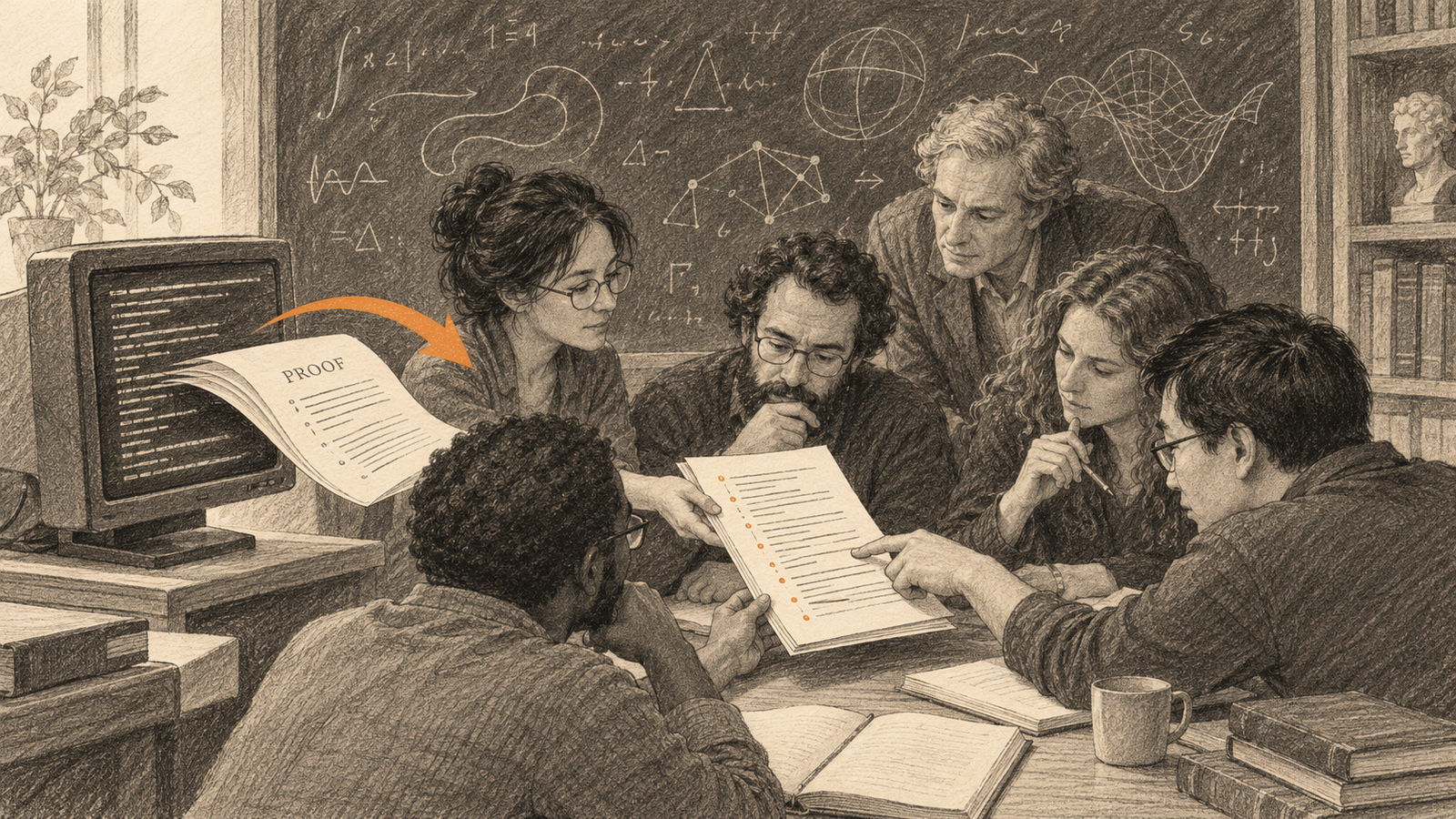
An AI-generated proof is not just an impressive answer. It is a mathematical claim that other people need to inspect, understand, and verify.
On October 6, 2026, OpenAI published a collection of mathematical results from an internal model, including Lean formalizations for many proofs. The release quickly prompted a debate about review, attribution, and how research should be communicated.
What OpenAI released
OpenAI says the work came from an internal frontier model. It published results in a GitHub repository, included revision and citation protocols, and shared Lean formalizations for many proofs. Lean is a proof assistant: it can check whether a formal proof follows from its definitions and rules.
The company also says it consulted an independent advisory group and intends to improve the exposition and citation practices in future releases. A formalized proof is useful evidence, but it does not automatically explain why the result matters or how it fits into the surrounding literature.
Why mathematicians objected
The Association for Human Mathematics responded that the release did not follow the research norms it considers important. Its statement questioned the scale and presentation of the publication and urged readers to be skeptical of the claimed contribution.
That criticism is about process and scholarly practice as well as correctness. A proof may be formally checkable and still be difficult to interpret, poorly contextualized, or released without the forms of peer discussion that help a field absorb new ideas.
Verification has several layers
For a mathematical result, ask:
- Can the formal proof be checked by the stated proof assistant?
- Does the formal statement match the intended theorem?
- Can specialists understand the reasoning and evaluate its significance?
- Are prior work, contributors, and unresolved questions described accurately?
These checks answer different questions. Passing one does not automatically settle the others.
A productive standard
AI can help mathematicians explore ideas and formalize arguments. The strongest research workflow makes its evidence inspectable, states uncertainty clearly, and gives experts enough context to review the work.
The current debate is therefore not simply “AI can prove theorems” versus “AI cannot.” It asks how a community should validate, credit, and communicate results when a model can produce work faster than people can digest it.
Sources: OpenAI's October 6 release and the Association for Human Mathematics statement reposted by Terence Tao.