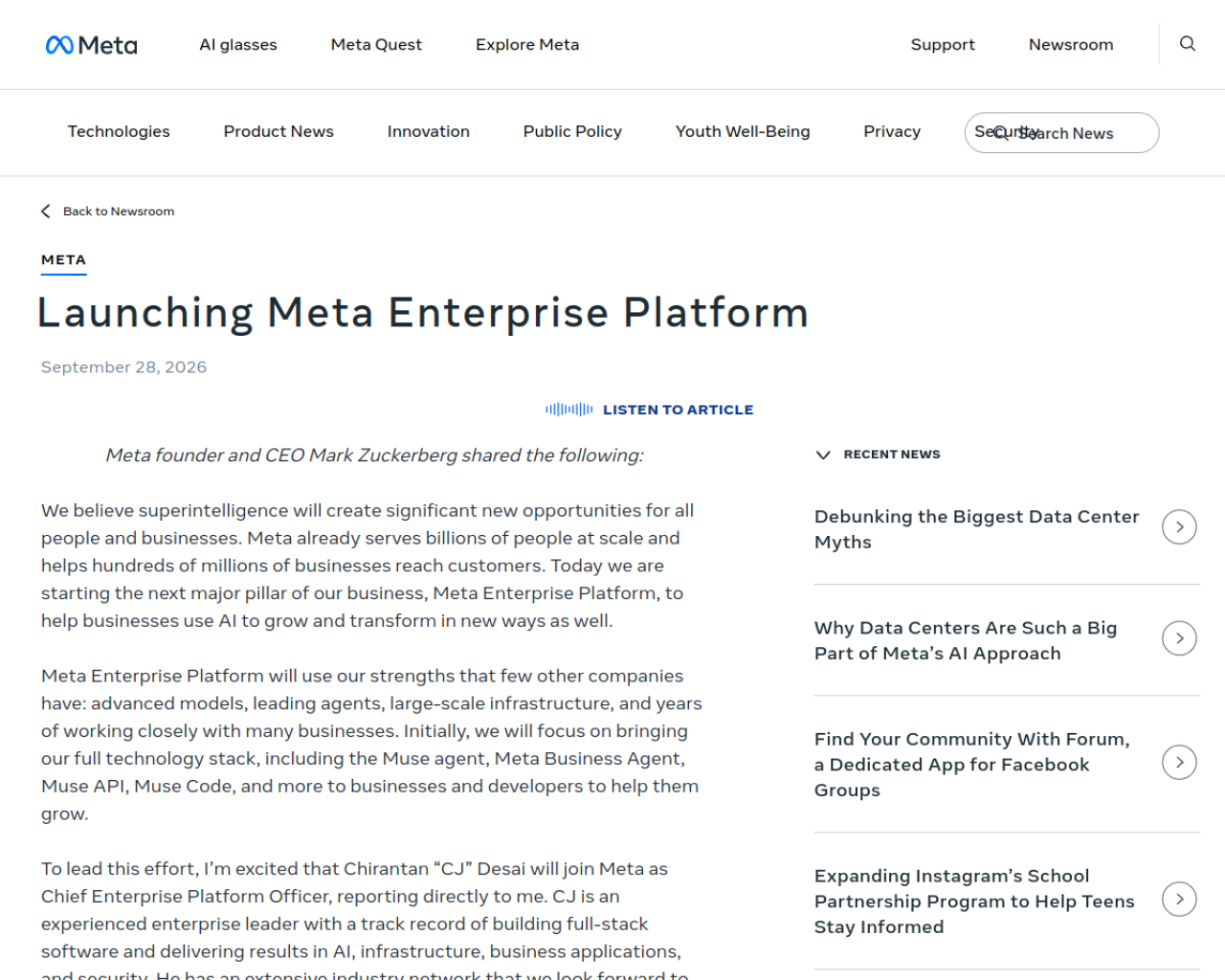
Meta Enterprise Platform is Meta's new business-facing effort to bring its AI models, agents, and developer tools to organizations. Mark Zuckerberg announced the platform on September 28, 2026.
The launch matters because it moves Meta's AI story beyond consumer assistants and social apps. This guide summarizes the announced components and the questions businesses should answer before adopting them.

What Meta announced
Meta says its enterprise platform will initially bring together its technology stack for businesses and developers. The announcement names the Muse agent, Meta Business Agent, Muse API, and Muse Code. Meta also named Chirantan “CJ” Desai as Chief Enterprise Platform Officer.
The company presents this as a new business pillar built on its models, agent technology, infrastructure, and experience serving businesses. The announcement describes the direction of the platform, but specific deployment, governance, and commercial terms need to be checked in product documentation as they become available.
How businesses should evaluate it
Start with a real workflow, not the phrase “AI platform.” Identify which records the agent needs, which systems it may change, and where a person must approve an action.
Then check the operational details: data retention, access controls, audit logs, regional availability, support commitments, pricing, and integration limits. These details determine whether an agent can be used safely in customer support, sales, or internal operations.
For a pilot, keep the first task narrow and reversible. Measure whether the system saves time without increasing error correction or introducing new privacy risks. Avoid granting broad permissions until the agent's behavior is observable and bounded.
Why the launch is worth watching
Meta has large consumer platforms and an expanding set of AI products. An enterprise offering could make those capabilities available to businesses in a more structured way. The launch announcement is an opening statement; the practical value will depend on the tools, controls, and service terms that follow.
The sensible response is to track the platform's release details and test one bounded workflow when access is available.