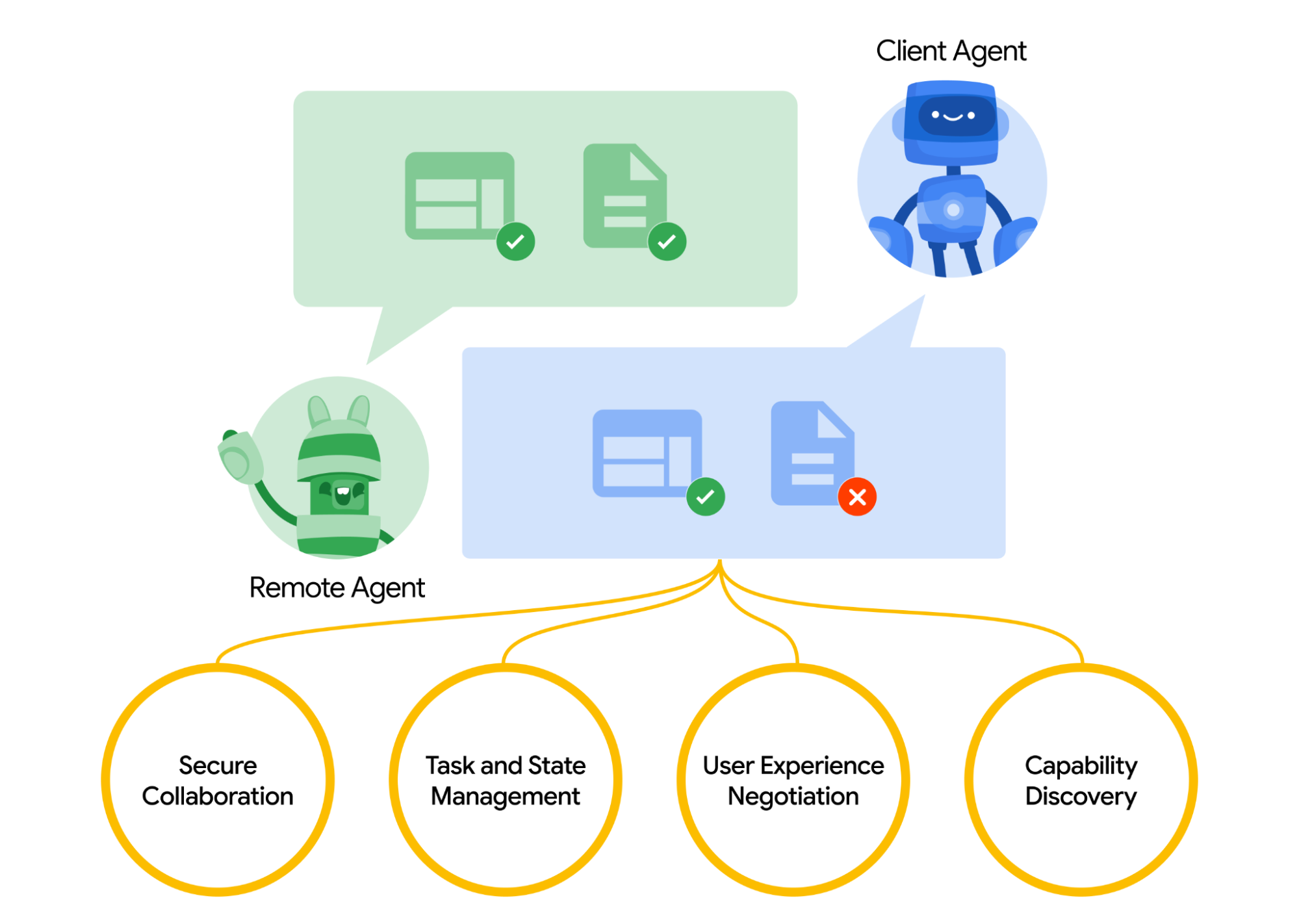
The A2A Protocol represents a significant advancement in the field of AI agent interoperability. This guide will walk you through the core concepts, benefits, and practical applications of this groundbreaking technology.
What is A2A Protocol?
A2A Protocol is an open standard that enables AI agents to communicate and collaborate across different platforms and frameworks. It's designed to maximize the benefits of agentic AI by enabling true multi-agent scenarios.
Key Features
-
Universal Interoperability
- Enables agents to work together seamlessly
- Platform and framework agnostic
- Supports various AI models and architectures
-
Enterprise-Grade Security
- Built-in authentication and authorization
- Support for OpenAPI authentication schemes
- End-to-end encryption
-
Flexible & Scalable
- Supports quick tasks to long-running research
- Real-time feedback and state updates
- Distributed architecture
Benefits of A2A Protocol
The A2A Protocol offers numerous advantages for organizations and developers:
- Reduced Development Time: No need to build custom integration solutions
- Enhanced Collaboration: Seamless communication between different AI systems
- Future-Proof: Designed to evolve with the AI landscape
- Cost-Effective: Leverage existing AI investments
Getting Started
To begin using the A2A Protocol:
- Review the documentation
- Explore the code samples
- Join the community
Conclusion
The A2A Protocol is revolutionizing how AI agents interact and collaborate. By adopting this standard, organizations can unlock new possibilities in AI development and deployment.
Stay tuned for more articles in our series, where we'll dive deeper into specific aspects of the A2A Protocol and its implementation.
Related Articles
- A2A vs MCP: The Protocol Revolution in AI Architecture
- Python A2A: A Comprehensive Guide to Google's Agent2Agent Protocol
- A2A Sample Methods and JSON Responses
- Building an A2A Currency Agent with LangGraph
- Python A2A Tutorial with Source Code
- A2A Typescript Guide
Go A2A
Discover Products
Discover useful AI products and services.
Decisions API brings multiple AI decision models into one workflow for classifying, scoring, routing, and evaluating text with structured outputs.
Build smarter AI workflows with a unified API for classification, scoring, routing, verification, and other structured decisions.
Try Jev AI Model online for free after sign in. Classify, score, and route text with structured results. Buy credits for API access.
The Discord bot maker your server actually needs

Turn any flat image into named, editable layers—separate text, subjects, decorations, and backgrounds in just a few clicks.

Start with a simple prompt, then let our AI OC Maker turn your idea into anime characters, fantasy OCs, roleplay avatars, and full-body character designs.
Related Articles
Explore more content related to this topic
2026 Complete Guide to GLM-OCR for Next-Gen Document Understanding
GLM-OCR is a 0.9B-parameter multimodal OCR model built on the GLM-V architecture, designed for complex document understanding, not just text extraction. Delivers structure-first outputs (semantic Markdown, JSON, LaTeX), accurately reconstructing tables, formulas, layout, and handwriting across 100+ languages with state-of-the-art OmniDocBench V1.5 performance (94.62) at ~1.86 PDF pages/second.
The A2UI Protocol: A 2026 Complete Guide to Agent-Driven Interfaces
Discover A2UI, the security-first declarative UI protocol that enables AI agents to generate rich, interactive user interfaces. Learn how A2UI solves the 'Chat Wall' problem, achieves security through data vs. code separation, and enables dynamic cross-platform interfaces. Includes real-world examples and implementation guidance.
Python A2A: A Comprehensive Guide to Google's Agent2Agent Protocol
Master the Python A2A protocol for building interoperable AI agents. Learn how to create, connect, and orchestrate AI services with standardized communication, from basic echo agents to complex multi-agent workflows.
The Complete Guide to A2UI Protocol: Building Agent-Driven UIs with Google's A2UI in 2025
A comprehensive guide to A2UI (Agent to UI), a declarative UI protocol for agent-driven interfaces. Learn how AI agents generate rich, interactive UIs that render natively across platforms without executing arbitrary code.
A2UI Introduction - Declarative UI Protocol for Agent-Driven Interfaces
Discover A2UI, the declarative UI protocol that enables AI agents to generate rich, interactive user interfaces. Learn how A2UI works, who it's for, how to use it, and see real-world examples from Google Opal, Gemini Enterprise, and Flutter GenUI SDK.