What Is Jev AI Model? The 2026 Complete Guide to the Decision Model, Playground, API & Pricing
🎯 Key Takeaways (TL;DR)
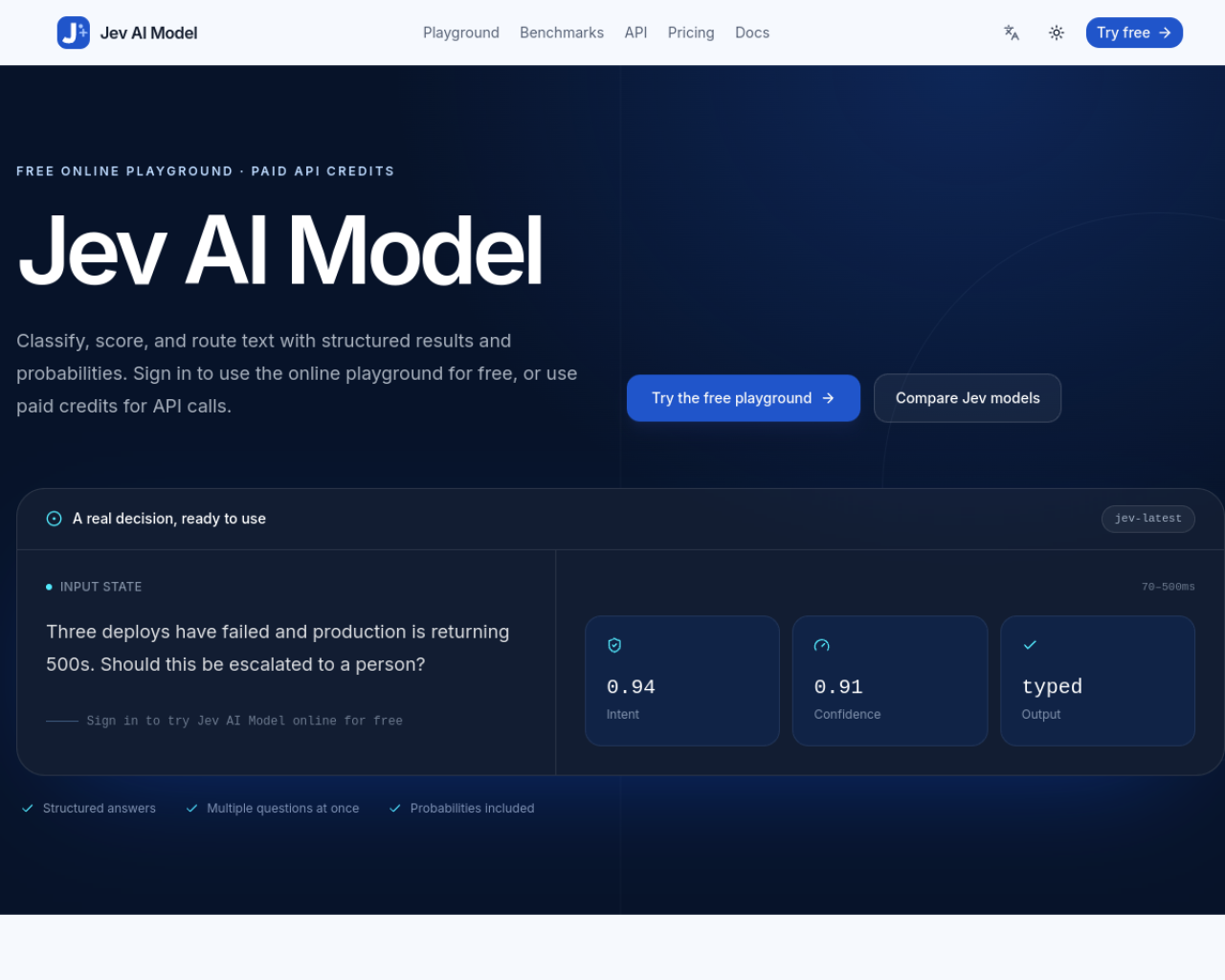
- Jev AI Model is not a chatbot and doesn't generate text: it's a "decision model" that takes a state (a ticket, message, or JSON object) plus typed questions, and returns structured answers with probabilities — output your code can branch on directly, with no prose to parse.
- Three question types cover the decision layer of most software: Choice (classification), Score (continuous rating), and Noul (yes/no judgment) — batched in one request, each answered with probabilities and a confidence score.
- Free playground, one-time pricing, no subscription: test free after sign-in at jevaimodel.net; API credits start at $10 (100,000 credits) and never expire — $100 Pro and $1,000 Enterprise tiers add throughput and team features.
- It targets the layer LLMs handle badly: small decisions made thousands of times a day (route, escalate, block, approve) — where per TypeSafe's published benchmark a decision runs up to 193.6x faster and 444.6x cheaper than the comparable LLM workflow.
- Know the boundaries: text/JSON input only (no images, audio, video), English-first accuracy, and validate non-English inputs separately before production.
Table of Contents
- What Is Jev AI Model — and What Is a "Decision Model"?
- How Does Jev Work? State, Questions, Typed Answers
- Jev vs LLM Structured Outputs: When to Use Which?
- How to Use Jev AI Model: Three Paths
- Jev AI Model Pricing: What Does It Cost?
- What Are the Real Use Cases?
- Limitations and Caveats
- FAQ
- Conclusion and Next Steps
What Is Jev AI Model — and What Is a "Decision Model"?
Jev AI Model is the model behind jevaimodel.net, and the site's positioning is unusually blunt: "Not chat. A decision inside your system." The premise is that the hardest product work today isn't generating another paragraph — it's making small decisions many times a second without losing control. Routing a ticket. Scoring a lead. Deciding whether a message needs a human.
A decision model is built for exactly that layer. Instead of the LLM pattern (prompt → free text → parse → retry), Jev inverts the contract:
- You define the answer space up front — the possible answers are part of the request, so the output is guaranteed to fit your schema.
- You ask typed questions, not open prompts — classification, scoring, or yes/no.
- Every answer carries probabilities and confidence — so your system knows when to decide alone and when to escalate to a person.
The model line is called "System One" (from psychology's fast/intuitive System 1 vs deliberate System 2): the idea that machine-to-machine decisions don't need natural language at all — they need fast, cheap, self-consistent judgments that behave "more like code."
💡 Pro tip If you're currently prompting an LLM with "classify this as A/B/C and respond in JSON," that's exactly the workload Jev AI Model is designed to replace — the JSON parsing, retry logic, and hallucinated-format failures disappear because the structure is enforced by the request itself.
How Does Jev Work? State, Questions, Typed Answers
The API has two core concepts. A state — the data to evaluate: a support ticket's text, a message, form fields, or any JSON object your system already holds. And questions — typed questions about that state, in three varieties:
| Question type | What it answers | Returns | Example |
|---|---|---|---|
| Choice | Classification with defined options | Selected option + per-option probabilities + confidence | "intent: billing / bug / feature request" |
| Score | Continuous rating against a scale | Score + distribution + confidence | "customer frustration, 0–2" |
| Noul | Yes-or-no judgment against criteria | Probability the statement is true (e.g., 0.95) | "Does this ticket need a human?" |
Multiple questions can be evaluated against the same state in one request, in parallel — so "which team? how urgent? how frustrated? does it need review?" costs one call, not four.
The result is designed to land directly in control flow: if result.needs_human: escalate(). The site describes the separation of concerns plainly: you give it state, you ask the question, and code acts — Jev only handles the decision in the middle, while your system keeps ownership of what happens next.
💡 Pro tip Batch your questions. Because every question about a state is evaluated in parallel in one request, "which team + how urgent + needs review?" is one call — the pattern that makes per-message decision costs disappear.
graph TD
    A[Your system: ticket / message / JSON state] --> B[Jev: typed questions — Choice, Score, Noul]
    B --> C[Typed answers + probabilities + confidence]
    C --> D{Confidence above threshold?}
    D -->|Yes| E[Act automatically: route, queue, block, approve]
    D -->|No| F[Escalate to a human]
    E --> G[Your business logic stays yours]
    F --> G
Jev vs LLM Structured Outputs: When to Use Which?
Modern LLMs have JSON mode and function calling — so why a dedicated decision model? The comparison comes down to what each is optimized for:
| Dimension | Jev AI Model (decision model) | LLM structured outputs |
|---|---|---|
| Output | Typed answer + probability, schema-enforced | JSON parsed from generated text |
| Speed per decision | ~0.1s class (per TypeSafe's benchmark) | Seconds |
| Cost per decision | ~$0.000081 (benchmark figure) | ~$0.014 for comparable workflow |
| Batch questions | Multiple per request, parallel | Multiple calls or one large prompt |
| Uncertainty signal | Native probability + confidence | Varies; often absent |
| Failure mode | Low-confidence answer you can gate | Invalid JSON / hallucinated fields |
| Best at | High-volume routing, scoring, gating | Open-ended reasoning, drafting, planning |
Per TypeSafe's published benchmark, the contrast is roughly two orders of magnitude: up to 193.6x faster and 444.6x cheaper on System One task workflows (~$0.000081 / 0.114s per decision vs ~$0.01388 / 8.566s for the LLM comparison). Vendor-run benchmarks deserve skepticism, but the direction is structurally true: a small typed model does less work than a large generative one.
⚠️ Note Jev doesn't replace your LLM — it replaces the small, repetitive decisions you're currently delegating to it. The durable architecture in 2026 is complementary: the LLM handles open-ended reasoning (System Two), Jev handles high-volume fast judgments (System One).
How to Use Jev AI Model: Three Paths
Path 1: The free online playground
- Open jevaimodel.net and sign in — free, with Google One Tap supported.
- Paste a real scenario as the state (a support ticket, a message, form data).
- Define typed questions — choice, score, or noul.
- Inspect the typed decision with its probabilities before writing any code.
Path 2: The API
Create an API key and send states and questions to POST /v1/systemone — or use the official Python SDK:
from typesafe_sdk import Choice, Noul

response = client.system_one(
    state=ticket,
    questions={
        "intent": Choice(criteria={...}),
        "needs_human": Noul(instructions="Does this need a person?"),
    },
)
# response.answers["intent"].choice
Path 3: The Jev Agent Skill (Codex, Claude Code, Cursor)
npx skills add jev-ai/jev-agent-skill
export JEV_API_KEY="sk_your_key_here"
export JEV_LANGUAGE="en-US"
Install the public skill, configure one API key, and your coding agent gains a typed judgment layer for routing, guardrails, verification, and completion checks — the agent keeps control of final actions; Jev supplies the decision. English by default, Simplified Chinese supported.
✅ Best practice Start with one decision you can verify — e.g., triage intent on real support tickets in the playground — and compare Jev's confusion cases against your current logic before wiring it into production routing.
Jev AI Model Pricing: What Does It Cost?
The pricing model is the rarest kind: one-time purchases, no auto-renewal, credits that never expire.
| Plan | Price (one-time) | Credits | Concurrency | Standout features |
|---|---|---|---|---|
| Playground | Free (sign-in) | — | — | Full question types, typed output inspection |
| Starter | $10 | 100,000 (no expiry) | 3 requests | Validate one real workflow end to end |
| Pro (recommended) | $100 | 1,000,000 (no expiry) | 10 requests | Fast lane, parallel questions, usage history, priority support |
| Enterprise | $1,000 | 11,000,000 (10% bonus) | Unlimited | Dedicated fast lane, team workspaces, custom integration support |
For context on cost-per-decision: at Pro's 1,000,000 credits for $100, a single decision costs on the order of a hundredth of a cent — the class of pricing where "call it on every message" becomes economically reasonable, which is precisely the point of the category.
Beyond the official site, the Jev model line is also distributed through Cloudflare Workers AI (model ID typesafe/jev) and OpenRouter (typesafe/jev-1.13), with a LangChain integration (langchain-typesafe) — worth comparing if you already run infrastructure on those platforms.
What Are the Real Use Cases?
The site frames solutions around the decisions already "hiding in your code":
- Support triage: intent + urgency + frustration scored in one pass; auto-route the confident cases, escalate the rest.
- Guardrails and safety checks: noul-style gates ("is this output safe to send?") on agent pipelines, with confidence-triggered human review.
- Agent control flow: the Agent Skill lets Codex/Claude Code/Cursor agents request bounded judgments for routing, verification, and completion checks — the "should I continue?" decisions agents currently guess at.
- Lead and content scoring: continuous score questions against a defined scale, feeding prioritization queues.
- Form and message classification: any place a human reads text and picks from a fixed set of outcomes.
The unifying pattern: high volume, bounded answer space, and a cost to getting it wrong that's managed by confidence thresholds rather than perfection.
Limitations and Caveats
Honest boundaries, mostly from the official docs:
- Text, JSON objects, and arrays of text only — no images, audio, or video yet.
- English-first: non-English inputs should be validated separately for accuracy before production use (the site and agent skill support Simplified Chinese, and a /zh version exists).
- It's a judgment layer, not a knowledge layer — Jev decides on the state you give it; it doesn't retrieve facts or reason over long documents the way an LLM can.
- Vendor benchmarks (the 193x/444x figures) are TypeSafe's own — directionally credible for the workload class, but run your own comparison on your data.
- Probability calibration is model-specific — before gating on thresholds like 0.8, observe the confidence distribution on your real traffic.
🤔 FAQ
Q: What is Jev AI Model?
A: Jev AI Model is a "decision model" at jevaimodel.net that classifies, scores, and answers yes/no questions about text and JSON states — returning typed answers with probabilities instead of generated text, for direct use in application logic.
Q: Is Jev AI Model free?
A: The online playground is free after sign-in. API calls use paid credits: $10 (100,000 credits), $100 (1,000,000), or $1,000 (11,000,000) — all one-time purchases with no expiry and no auto-renewal.
Q: How is Jev different from an LLM with JSON mode?
A: JSON mode still generates text that must parse; Jev enforces the answer space in the request itself and returns probabilities with every answer. Per TypeSafe's benchmark it's up to ~194x faster and ~445x cheaper per decision — designed for high-volume routing/scoring, not open-ended reasoning.
Q: What are Choice, Score, and Noul?
A: The three question types: Choice classifies into defined options, Score rates on a continuous scale, Noul answers a yes/no question with a probability. Multiple questions can be batched per request in parallel.
Q: Can I use Jev AI Model with Claude Code or Cursor?
A: Yes — install the public Jev Agent Skill (npx skills add jev-ai/jev-agent-skill), set your API key, and your agent can request typed judgments for routing, guardrails, and verification while keeping final control of actions.
Q: Does Jev support Chinese or other languages?
A: The site and agent skill support English and Simplified Chinese, with a Chinese version at jevaimodel.net/zh. Accuracy on non-English inputs should be validated separately before production use.
Q: Can Jev process images or audio?
A: No — currently text, JSON objects, and arrays of text only. Images, audio, and video are not supported.
Conclusion and Next Steps
Jev AI Model represents a clean split in the AI stack: LLMs for open-ended reasoning, and a typed decision layer for the thousands of small judgments software makes every day. With a free playground, one-time credit pricing that never expires, and an agent skill that plugs into the tools developers already use, the barrier to testing it is close to zero.
Next steps:
- Try one real decision free — open the Jev playground, paste a real ticket or message, and compare its typed answers against your current logic.
- Run the $10 experiment — if the playground looks right, Starter credits are enough to validate one production workflow with real traffic.
- Check the benchmark — the site publishes an independent-style evaluation of decision quality, calibration, speed, and cost per decision; run your own alongside it.
- If you build with agents — install the Agent Skill in Claude Code, Codex, or Cursor and let it own the routing/guardrail judgments instead of prompting your way to them.
Sources: Jev AI Model official site · Jev pricing page · TypeSafe benchmark (via official materials) · Jev Agent Skill docs (jev-ai/jev-agent-skill)
Last updated: September 23, 2026. Product features and pricing verified against the official site on this date — re-check before purchase.