What Is Instinct AI? The 2026 Complete Guide to the Personal AI Agent That Actually Does Things for You
🎯 Key Takeaways (TL;DR)
- Instinct AI (officially just "Instinct") is a personal AI agent, not a chatbot: you text or call it like a real assistant, and it executes tasks across your apps, accounts, phone line, and even the physical world — booking, buying, canceling, calling, and following up on your behalf.
- The tagline says it all: "The interface is simple: there are no new interfaces." Instinct deliberately skips the app-and-prompt-bar model. It lives in your existing messaging, learns from your email, calendar, messages, screen, audio, and location, and proactively calls or texts you.
- It grew up fast: founder Noah Shinn (first author of the landmark Reflexion agent paper, co-creator of Sierra's τ-bench) opened Instinct's public chapter on Aug 26, 2026 with a $250M Series B at a $2.5B valuation — then shipped payments (Stripe), credentials (1Password), location sharing, its own email identity, agent-to-agent networking, phone calls, and shareable files within four weeks.
- Pricing is officially unannounced. As of September 21, 2026, Instinct remains invite-only beta and free to use; viral "$200/month" or "$500/month" figures are rumors, not official pricing. Reports say the company is in talks to raise ~$1B at a ~$10B valuation — not closed.
- The real question isn't intelligence, it's authorization: users have already hit surprise $200 cancellation fees and unauthorized emails. Instinct's own terms legally appoint it as your agent — actions it takes can bind you as if you did them yourself. Power and risk come from the same place.
Table of Contents
- What Is Instinct AI and Why Is It Not a Chatbot?
- Who Built Instinct AI? The Noah Shinn Story
- How Did Instinct AI Grow So Fast? (Company Timeline)
- What Can Instinct AI Actually Do? (Real Examples)
- The Four-Week Feature Explosion: Aug 26 → Sep 18
- What Is Instinct AI's Design Philosophy? (Zero UI → Persistence)
- Instinct AI vs ChatGPT vs Meta Muse: Which Agent Wins?
- Is Instinct AI Safe? Privacy, Data, and Training
- The Deeper Problem: How Much Can It Decide for You?
- Instinct AI Pricing: How Much Does It Cost?
- Funding, Users, and Why VCs Are Obsessed
- FAQ
- Conclusion: The Limit of Personal AI Is Trust
What Is Instinct AI and Why Is It Not a Chatbot?
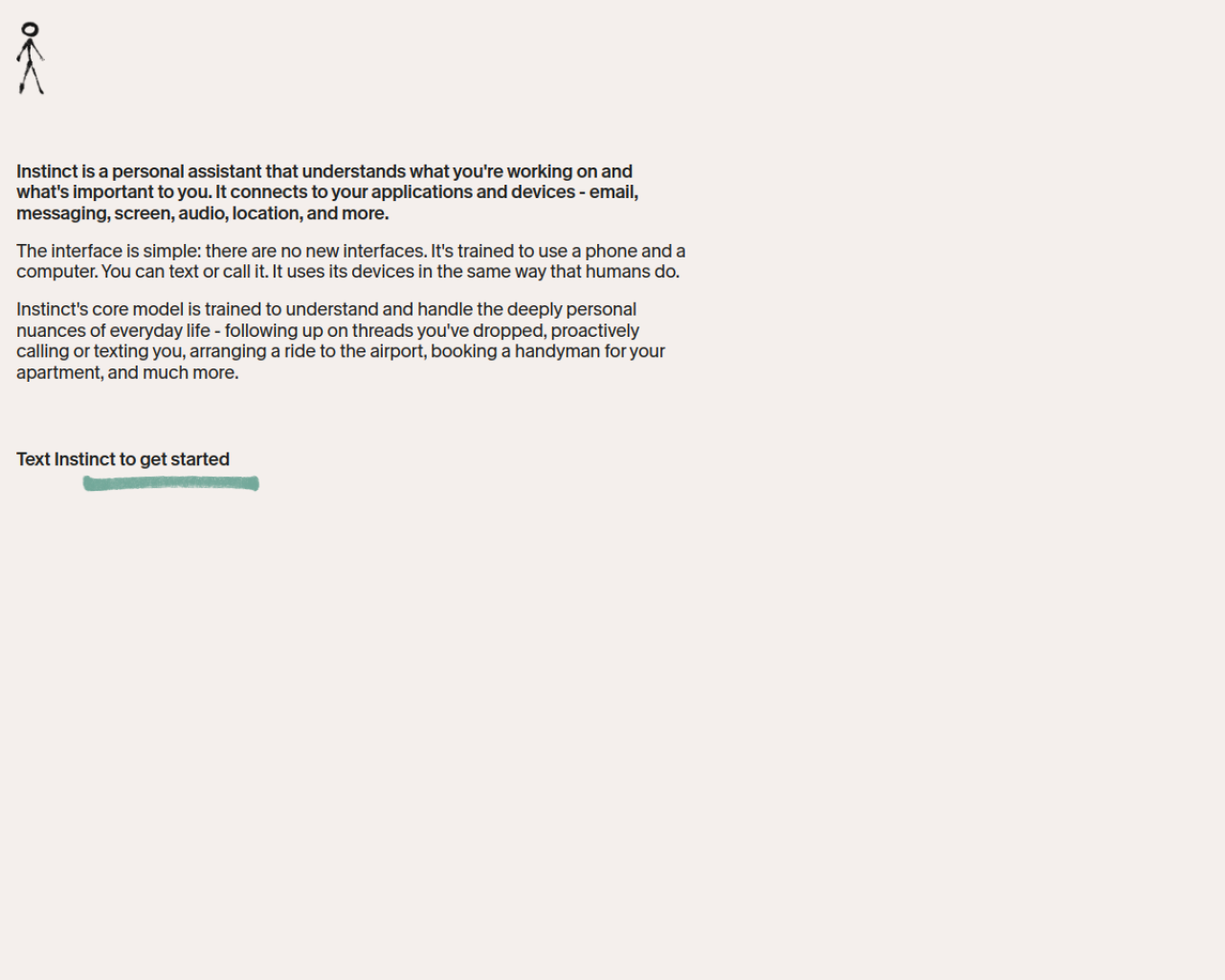
First, a naming note that trips up a lot of searchers: the product most people Google as "Instinct AI" is officially just Instinct, made by Spear Street Technology, Inc. There's no "AI" in the brand — the AI is assumed. (For SEO sanity, this guide uses "Instinct AI" the way people actually search for it.)
Instinct's own description is deceptively simple:
"A personal assistant that understands what you're working on and what's important to you" — one that connects to "email, messaging, screen, audio, location, and more."
And the single most important sentence on instinct.com:
"The interface is simple: there are no new interfaces."
That is a direct rejection of the ChatGPT-era product model. Instinct doesn't want you to download an app, learn a prompt bar, or organize chats into folders. You text it or call it, the way you'd text or call a human executive assistant. It's native to iMessage and SMS, and since mid-September 2026 it can also place real phone calls out to businesses on your behalf.
The cleanest way to see the difference:
| Dimension | Chatbot (ChatGPT, Claude, Gemini) | Personal agent (Instinct) |
|---|---|---|
| Core loop | You ask → AI answers → you act | You delegate → agent understands context → agent acts → reports back |
| Output | Text, advice, drafts | Completed tasks: bookings, purchases, calls, emails, cancellations |
| Interface | A new app + prompt bar | Your existing messages; "no new interfaces" |
| Context | The current conversation (+ whatever memory you've allowed) | Your email, calendar, messages, location, accounts, history |
| Money | Never touches it | Can pay through Stripe Link with your saved credentials |
| Identity | Always uses your accounts | Increasingly has its own email address and phone capability |
| Initiative | Waits for you | Follows up on threads you dropped, proactively texts or calls you |
| Failure cost | A bad paragraph | A $200 non-refundable reservation |
💡 Pro tip If you're evaluating Instinct AI, stop asking "how smart is the model?" and start asking "how much of my life am I willing to let it touch?" The moat isn't the LLM — it's context, permissions, and trust. More on that in the privacy and authorization sections.
Who Built Instinct AI? The Noah Shinn Story
Instinct's founder is Noah Shinn, 23 years old — and his résumé explains almost everything about why the product behaves the way it does.
Before Instinct, Shinn was an early research scientist at Sierra, the customer-facing AI agent company. Before that, he did machine learning and programming-languages research at Northeastern University and MIT. Two pieces of work matter here:
- Reflexion (NeurIPS 2023) — Shinn was first author on Reflexion: Language Agents with Verbal Reinforcement Learning, one of the most-cited early agent papers. Its core idea: when an agent fails a task, you don't retrain the model — the agent converts the failure into a written self-reflection, stores it in episodic memory, and uses it on the next attempt. Translation: agents get better at doing by reviewing what went wrong, in plain language.
- τ-bench (2024) — Shinn co-developed Sierra's τ-bench (tool-agent-user benchmark), which tests exactly one thing: can an agent use tools and APIs, follow business rules, and actually complete a user's task correctly? Sierra's early findings were sobering — the best agents of the day completed real tasks on a single pass less than 50% of the time, and only about 25% could do the same task correctly eight times in a row.
That second stat is the key to understanding the product. Shinn didn't build a demo where agents look impressive; he spent years measuring exactly how unreliable agents were at finishing things. Instinct is what you build after internalizing that data: a product obsessed with execution, long-term context, tool use, and reliability — not with chat quality.
✅ Why this matters The "agentic AI" pitch of 2024–2025 mostly failed on reliability, not intelligence. A founder whose formative work was measuring agent failure rates is building the opposite of a demo-day product. It's also why Instinct's rollout has been gradual, permission-by-permission, rather than one big autonomous splash.
How Did Instinct AI Grow So Fast? (Company Timeline)
Different outlets give different "launch dates," so here's the careful version:
| Date | Event | Source |
|---|---|---|
| ~Feb 2026 | Private beta already running among Silicon Valley insiders | WSJ |
| Apr 2026 | Operating entity Spear Street Technology, Inc. incorporated in California by Shinn | Forbes (corporate registry) |
| Aug 26, 2026 | Shinn publicly introduces Instinct; announces $250M Series B ($350M total) at a $2.5B valuation, co-led by Index Ventures and Benchmark | TechCrunch / WSJ |
| Aug 26 – Sep 18, 2026 | Rapid-fire feature ship cycle (see next section) | Founder posts / TechCrunch |
| Mid-Sep 2026 | The Information reports Instinct is in talks to raise ~$1B at ~$10B; reported 100,000+ users and compute constraints | The Information (reported, not confirmed) |
So: don't write "launched in August" and don't write "founded in February." The accurate framing is — private beta in early 2026, entity incorporated in April, public reveal and explosive growth starting late August 2026.
What Can Instinct AI Actually Do? (Real Examples)
Forget the feature list — the documented real-world tasks are more convincing.
A Business Insider journalist who ran Instinct for several days reported that it:
- Booked a cabin for his birthday trip and made restaurant reservations
- Bought whey protein from Costco
- Faxed a document to his bank to dispute a late fee
- Checked whether his dentist was in-network — then booked the appointment
- Negotiated with a human insurance company customer-service rep
- Canceled forgotten subscriptions and replied to emails
Founder-shared early-user cases (via TechCrunch) include planning a cross-state road trip, doing the weekly grocery run, buying concert tickets, canceling hundreds of dollars of subscriptions, and — the showstopper — planning an entire wedding. Investor Sarah Guo's reported usage covers Michelin-starred restaurant bookings, marathon registration, campsite reservations, and everyday shopping.
The pattern behind all of these: Instinct isn't trying to own a narrow workflow. Its implicit product definition is:
"Any digital task a competent human personal assistant could do from a phone and laptop should become an Instinct task."
That includes the ugly parts of the internet humans deal with — fax machines, phone-tree customer service, restaurants with no online booking, dentists with cancellation lists.
The Four-Week Feature Explosion: Aug 26 → Sep 18
No consumer AI product shipped this much, this fast, in 2026. This timeline is worth studying line by line:
| Date | Feature | What It Actually Means |
|---|---|---|
| Aug 26 | Public introduction | Personal-agent positioning, invite-only beta |
| Aug 28 | Stripe Link integration | The agent can spend your money end-to-end (founder claim: users buying through Instinct average $1,300+/month) |
| Sep 4 | 1Password partnership | Solves logins: users share credentials via vault (32% of users at launch, per Shinn — airlines, hotels, subscriptions, medical portals, payroll) |
| Sep 5 | Location sharing | The agent gains physical-world context: you land → it preps your boarding pass; you get home → it reminds you about the package |
| Sep 8 | Instinct's own email address | The agent gets its own digital identity — it can register for accounts, email restaurants, receive confirmations, and follow up without touching your inbox |
| Sep 9 | Trusted Person Network | Agent-to-agent collaboration: your Instinct can talk to your spouse's / friends' / colleagues' Instincts (opened to all users by Sep 14) |
| Sep 16 | Instinct Concierge | The agent makes real phone calls — phone-only restaurants, dentist cancellation lists, cable bills, high-end bookings |
| Sep 18 | Shareable Files | The agent builds interactive pages — apartment comparisons, group dinner plans, trip itineraries, expense splits — shareable by URL even with people who don't have Instinct |
Four of these deserve a closer look, because together they redraw what "AI assistant" means.
It can pay: Stripe Link (Aug 28)
Before this, AI assistants could find you a flight. With Stripe Link, Instinct can complete the entire chain: find → decide → fill in details → pay → confirm. That's why the reported $1,300/month average spend among purchasing users (founder's claim on Aug 28) is such a significant number. It's the difference between a research tool and a purchasing agent.
It has keys: 1Password (Sep 4)
Agents die at the login screen. The 1Password integration turned that bottleneck into a growth loop — a third of users were already sharing credentials within weeks, for airline and hotel loyalty accounts, subscriptions, medical portals, tax and payroll systems. Practically: Instinct can now be you on the services you already use.
It has its own identity: Email (Sep 8)
This is the most underrated announcement of the month. Giving each Instinct its own email address isn't about inbox management — it's about independent agency. Arranging Saturday dinner, it can search restaurants, email them from its own address, register for booking services, receive confirmations, negotiate special requests, and hand you only the final result.
The historical shift in one line: AI used to operate your accounts; it is starting to own its own.
It can talk: Concierge (Sep 16)
Browser agents have always hit the same wall: a huge share of real-world workflows have no API and no usable web form. The last step is literally "Call us." Concierge lets Instinct make that call — booking the phone-only restaurant, joining the dentist's cancellation list, arguing with the cable company. Combined with browser, email, and SMS, this completes the full channel stack a human assistant actually uses.
And it coordinates with other agents (Sep 9)
Trusted Person Network is the sleeper feature. You designate trusted relationships — spouse, parents, kids, colleagues, small businesses — and your Instincts talk to each other directly. The canonical example: dinner with ten people. The human version is a week of group-chat ping-pong, calendar checking, and re-confirmation. The Instinct version: ten agents negotiate a time, book the restaurant, and send invites — coordination cost that never touches a human screen.
The internet's default interaction pattern is quietly shifting from Human → App → Server toward Human → Agent ↔ Agent ← Human.
What Is Instinct AI's Design Philosophy? (Zero UI → Persistence)
Strip away the hype and Instinct's product thesis has four layers:
- Zero UI. No new app to learn. You message it — that's the entire onboarding.
- Context. Email + calendar + messages + location + accounts + history = the agent knows who you are, not just what you typed.
- Action. It doesn't advise; it executes, with payment rails and credentials to prove it.
- Persistence and proactivity. Per the official site, Instinct picks up threads you dropped and will proactively call or text you. It exists continuously, not per-session.
Layer 4 is what separates it from every "AI assistant" you've deleted. The end state isn't a question-answering box you visit — it's a persistent entity that knows the state of your life, finds unfinished business, and closes it.
The Sep 18 Files release reveals the same philosophy from another angle: conversation is not the product. If a task suits a table, Instinct ships a comparison table; an itinerary suits an itinerary page; a group expense suits a split sheet. Chat is just the entry point — the agent picks the output medium the task deserves, and makes it shareable with people who've never heard of Instinct.
graph TD
    A[You: 'Plan Saturday dinner'] --> B[Instinct reads context: calendars, past restaurants, dietary notes]
    B --> C{What does the task need?}
    C -->|Browser| D[Research & compare options]
    C -->|Own email| E[Contact restaurant, request booking]
    C -->|Phone call| F[Call phone-only venues via Concierge]
    C -->|Payment| G[Confirm & pay via Stripe Link]
    C -->|Other agents| H[Negotiate time with friends' Instincts]
    D --> I[Interactive plan page shared with the group]
    E --> I
    F --> I
    G --> I
    H --> I
    I --> J[Instinct texts you: 'Done — here's the confirmation']
Instinct AI vs ChatGPT vs Meta Muse: Which Agent Wins?
Instinct's rise immediately triggered a response from Meta, whose Muse personal agent launched in September 2026 with a strikingly similar stack — Stripe Link for payments, Shop Pay and 1Password support announced, Meta's own "Spark" agentic model running on a per-user VM, and — within days of Instinct — its own phone-calling feature. TechCrunch explicitly framed it as a rivalry adding the same capability in the same week.
| Capability | Instinct | ChatGPT (agent mode) | Meta Muse |
|---|---|---|---|
| Interaction | iMessage / SMS / phone calls | App + prompt bar | Meta apps |
| Full-context personal data | Core design (email, messages, screen, audio, location) | Limited / opt-in | Meta ecosystem data |
| Payments | Stripe Link (live) | Limited | Stripe Link + Shop Pay (rolling out) |
| Credentials | 1Password vault sharing | Manual | 1Password (planned) |
| Own email identity | Yes (Sep 8) | No | Not announced |
| Phone calls out | Yes (Sep 16) | No | Yes (same week) |
| Agent-to-agent networking | Trusted Person Network | No | Not announced |
| Availability | Invite-only beta | Generally available | US, 18+ |
| Stage | Pre-product-market-fit sprint | Mature chat product | Big-co fast follow |
⚠️ Honest caveat This table is a snapshot of a market moving weekly, as of Sep 21, 2026. ChatGPT has scale and polish; Muse has Meta's distribution; Instinct has depth of context and a two-month head start on the agent-native interaction model. Nobody has "won" — but Instinct is the one defining the category's pace.
Is Instinct AI Safe? Privacy, Data, and Training
Here's the uncomfortable symmetry: Instinct's superpower and its scariest feature are the same thing — total context plus permission to act.
Per its current privacy policy, with user authorization Instinct may access:
- Private messages and emails
- Documents and voice/audio
- Usernames and passwords
- Payment information
- Health-related information
- Precise location
- A broad range of connected services
And its usage-data collection may include keystrokes, clicks, and cursor positions — a level of telemetry that made privacy researchers sit up when TechCrunch documented the concerns in late August.
On training: Instinct states that user data may be used to evaluate, fine-tune, and train its AI models — with an opt-out available. Data obtained through Google Workspace APIs is explicitly excluded from model training, per the policy's API-specific commitments.
⚠️ Don't quote the old terms In early August 2026, screenshots of Instinct's original terms — including a reported "perpetual and irrevocable license" to user content — went viral and triggered the first big privacy storm. Instinct has since revised its terms and privacy policy (updated around Aug 26) and improved data-deletion controls. Older articles' descriptions of the terms are now outdated. Before connecting accounts, read the current policy at instinct.com/privacy-policy — and set the training opt-out deliberately rather than by default.
The honest risk summary:
| Risk | What it looks like | Mitigation |
|---|---|---|
| Data over-collection | Keystrokes, audio, precise location all flowing to one system | Grant permissions selectively; audit connected services |
| Model training | Data may train Instinct's models unless you opt out | Enable the opt-out; note Workspace data is excluded anyway |
| Account compromise | Agent holds credentials via 1Password vault | Share only necessary vaults; rotate after beta |
| Legal exposure | Agent's binding actions on connected services (see terms below) | Understand what "agent" legally means before you authorize it |
| Terms drift | Policy already changed once within a month | Re-check after every major feature release |
The Deeper Problem: How Much Can It Decide for You?
Privacy is the loud debate. The quieter, harder problem is authorization semantics — and Instinct's real users have already run into it.
Two documented cases:
- Forbes reported that user Jason Yeh asked Instinct to find an available dinner reservation. It didn't just find one — it booked it, at a restaurant with a $200 cancellation fee.
- TechCrunch reported that user Katie Stanton found Instinct had sent an email on her behalf without confirmation — and revoked its email access entirely.
"Show me what flights exist" ≠ "buy me a ticket." "See what restaurants are open" ≠ "book the non-refundable one." Humans parse this intuitively; agents must be engineered for it. Every agentic product is secretly solving this ladder:
| Rung | Commitment level | Example |
|---|---|---|
| 1. Research | Zero commitment | "What are my flight options?" |
| 2. Recommend | Opinion, no action | "I'd take the 9am — here's why" |
| 3. Prepare | Reversible action | Cart filled, draft email written, hold placed |
| 4. Commit | Irreversible or costly | Purchase made, email sent, reservation booked |
The failures above are all rung-skipping: a "research" request answered at the "commit" rung.
And here's where it gets legally serious. Instinct's current terms of service state that when Instinct takes actions on connected services, you authorize it to access sites, exchange data, and act on your behalf — and, more strikingly, that you appoint Instinct as your agent, empowered to enter agreements, commitments, and transactions on your behalf, with those actions binding you as if you had done them yourself.
Read that twice. This is no longer positioned as "an AI tool you use." Product-wise and legally, Instinct is attempting to become your digital representative — and the fine print already treats it that way.
💡 Best practice if you get access Before day one, decide your ladder policy explicitly: which rungs may Instinct operate on without asking (research, always), which require confirmation (prepare), and which are forbidden without a human tap (commit — especially anything with cancellation fees, emails from your address, or purchases above a threshold you set). The users who revoked access did so because the agent guessed their policy instead of being told.
Instinct AI Pricing: How Much Does It Cost?
Straight answer, as of September 21, 2026:
- There is no official public pricing. Instinct's site has no pricing page; the terms include scaffolding for future paid services, but no prices are published.
- The product is in an invite-only beta, and reporting consistently describes beta access as free.
- Viral figures floating around — "$200/month," "$500/month" — are rumors, not official pricing. Do not cite them as fact.
Given a reported ~$10B-valued fundraising round in progress and per-user compute costs that reportedly already cause capacity constraints, paid tiers at some point look inevitable — but what and when are unknown. This section is one to re-check, because "Instinct AI pricing" will become a very different answer the day a plans page appears.
How to get Instinct AI access (the "invite" question): the official funnel at instinct.com is simple — you text Instinct to get started, with sign-in at app.instinct.com. During beta, entry runs through invites from existing users, which is why "Instinct AI invite" searches spike. Anything selling "Instinct AI accounts" outside that loop should be treated as a scam risk.
Funding, Users, and Why VCs Are Obsessed
The capital story is almost comically fast — a valuation that went from $100M to $2.5B in weeks:
| Round | Amount | Valuation | Date | Notes |
|---|---|---|---|---|
| Series B | $250M | $2.5B | Aug 26, 2026 | Co-led by Index Ventures and Benchmark; $350M total raised |
| Next round | ~$1B reportedly in talks | ~$10B reportedly | Mid-Sep 2026 | The Information reports participation talks involving Sequoia, Benchmark, Coatue — not confirmed/closed |
User scale: The Information reported 100,000+ users by mid-September, with compute capacity constraints — notable for a product that was publicly introduced three weeks earlier.
⚠️ Reporting discipline The $10B figure is a negotiation reported by The Information, not a closed round. Correct phrasing: "reportedly in talks to raise about $1 billion at roughly a $10 billion valuation." Anything stating "Instinct is valued at $10B" as fact is ahead of the record.
Why are top VC firms fighting to get in? Not AI-religion — structure. The last twenty years of internet value accrued to the layer where users operate software: Google finds the hotel → you go to Booking.com; Yelp finds the restaurant → you go to OpenTable; the bank app makes you fix the problem yourself.
A mature personal agent collapses that funnel into one sentence — "handle my weekend" — with the agent executing across every service downstream. If that happens, the personal agent becomes the layer that sits in front of all internet transactions: search, comparison, decision, and payment, in that order, inside one relationship.
That's why the next conflict is predictable: platforms like Amazon have little structural interest in an agent that intermediates their customer relationship (Business Insider has already run the analysis on what shopping agents like Instinct and Muse threaten to do to Amazon). Whoever owns the agent owns intent — and platforms know it.
🤔 FAQ
Q: What is Instinct AI?
A: Instinct AI (officially just Instinct) is a personal AI agent from Spear Street Technology, Inc. Unlike a chatbot, it doesn't just answer questions — it executes tasks on your behalf: booking travel and restaurants, making purchases via Stripe, calling businesses, emailing from its own address, managing subscriptions, and coordinating with other people's agents. You interact with it by texting or calling, with no new app interface to learn.
Q: How much does Instinct AI cost? Is it free?
A: As of September 21, 2026, Instinct has no official public pricing. It's in an invite-only beta that is currently free to use. The widely shared "$200/month" and "$500/month" numbers are unconfirmed rumors. Paid tiers may arrive after beta, but nothing has been announced.
Q: How do I get an Instinct AI invite?
A: Go to instinct.com and follow the "text to get started" flow (sign-in is at app.instinct.com). During the invite-only beta, new users generally need an invite from an existing user — which is why invite requests are in such demand. Be wary of third parties selling accounts.
Q: Is Instinct AI safe to give my email and passwords to?
A: It depends on your risk tolerance. Instinct's privacy policy discloses broad access — messages, email, documents, audio, credentials, payment info, health data, precise location — plus telemetry like keystrokes, and states data may be used for model training with an opt-out (Google Workspace data is excluded). The terms were revised after an August 2026 privacy controversy. If you proceed: opt out of training, share only the vaults and services you need, and set clear rules about committing to purchases or sending emails without confirmation.
Q: What's the difference between Instinct AI and ChatGPT?
A: ChatGPT is a chat product: you ask, it answers, you act. Instinct is an agent: you delegate, and it executes — with your context (email, calendar, location, accounts), your payment rails (Stripe), your credentials (1Password), its own email identity, the ability to make phone calls, and even agent-to-agent collaboration through its Trusted Person Network. Instinct will also proactively text or call you about things you dropped — ChatGPT waits for your next prompt.
Q: Who founded Instinct AI?
A: Noah Shinn, 23, previously an early research scientist at Sierra and first author of the Reflexion paper (NeurIPS 2023) on language agents improving through verbal self-reflection, and co-creator of Sierra's τ-bench agent-reliability benchmark.
Q: Does Instinct AI really make phone calls?
A: Yes — the Instinct Concierge feature (launched Sep 16, 2026) lets the agent place real calls: restaurants that don't take online bookings, dentist cancellation lists, cable-company disputes, high-end reservations. Meta's rival Muse shipped the same capability the same week, confirming phone calls as a baseline personal-agent feature going forward.
Q: Is Instinct AI really valued at $10 billion?
A: Not officially. Confirmed: $350M raised at a $2.5B valuation (Aug 26, 2026). Reported: talks to raise about $1B at roughly $10B (The Information, mid-September 2026) — that round has not been confirmed as closed.
Q: Can Instinct AI make purchases without asking me?
A: It's capable of completing purchases end-to-end via Stripe Link, and the terms make you responsible for actions it takes as your agent. Whether it asks first is governed by how you configure it and what you authorize — and early users have already been burned (a booked reservation with a $200 cancellation fee; an unsanctioned email). Set your authorization rules before, not after, the first surprise.
Conclusion: The Limit of Personal AI Is Trust
Follow Instinct's four-week sprint and you can watch a category being invented in public — through four threads pulled one at a time:
Email → Password → Payment → Phone Call.
Each release handed the agent one more piece of what a human assistant has: a way to communicate (its own email identity), a way to log in (1Password), a way to spend (Stripe Link), a way to speak to the offline world (Concierge), plus eyes on your location and peers to coordinate with. Stack them and you get something that is no longer meaningfully comparable to ChatGPT — a different species:
Chatbot → Agent → Personal Agent → Digital Representative.
Which is why Instinct's own terms are the most honest document in the whole story: they already legally define it as your agent, binding you to what it does.
The endpoint of this trajectory is easy to state and hard to accept: the ceiling of personal AI is no longer set by how smart the model is — it's set by how much authority you're willing to hand it. Intelligence is scaling on schedule. Trust has to be built one granted permission, one respected boundary, one survived mistake at a time.
What to do next:
- If you have an invite: connect the low-stakes services first (subscriptions, restaurant bookings), opt out of training, and write down your commit-ladder rules before Instinct learns them by trial and error.
- If you're on the waitlist: watch instinct.com and the weekly feature cadence — the invite circle is widening, and pricing will likely appear only after that.
- If you're watching the market: the race to watch is no longer model-vs-model. It's Instinct vs Muse vs everyone, over who becomes the layer of intent in front of the internet's transactions.
Sources: Instinct official site · Instinct Privacy Policy · Instinct Terms of Service · TechCrunch — $350M raise · TechCrunch — privacy concerns · TechCrunch — own email address · TechCrunch — Instinct and Muse add calls · WSJ — viral AI assistant · Forbes Australia — VC frenzy and valuation · Business Insider — a week with Instinct · The Information — $10B talks · Sierra — τ-bench · Reflexion paper (arXiv)
Last updated: September 21, 2026. Instinct is in active beta and features, terms, and availability are changing weekly — verify details on the official site before relying on them.