Antique Scanner: How to Identify & Value Antiques by Photo (2026 Complete Guide)
🎯 Key Takeaways (TL;DR)
- Antique Scanner (antiquescanner.org) is an AI research tool that identifies antiques from photos — it reads maker's marks, hallmarks, materials, construction, and wear, then estimates age, origin, and market value.
- Every finding carries an honest confidence label — Identified, Likely, Possible, or Uncertain — with the evidence shown, so you know exactly how much to trust it. No guessing presented as fact.
- It's fast, cheap, and low-commitment: your first scan is free, a Full Antique Report costs a one-time $3.98 (no subscription), and most scans return in under two minutes.
- Best for: collectors, thrifters and resellers, and anyone handling inherited or estate items who needs a research starting point before buying, selling, or paying for a professional appraisal.
Table of Contents
- What Is an Antique Scanner?
- What Can You Scan?
- How Does Antique Scanner Work?
- What's Inside an Antique Scanner Report?
- Antique Scanner vs. Google Lens vs. Traditional Appraisal
- How to Photograph Your Antique for the Best Results
- Who Should Use an Antique Identifier?
- Pricing: What Does a Scan Cost?
- How Accurate Is It? Honest Limits
- Frequently Asked Questions (FAQ)
- Conclusion & Next Steps
What Is an Antique Scanner?
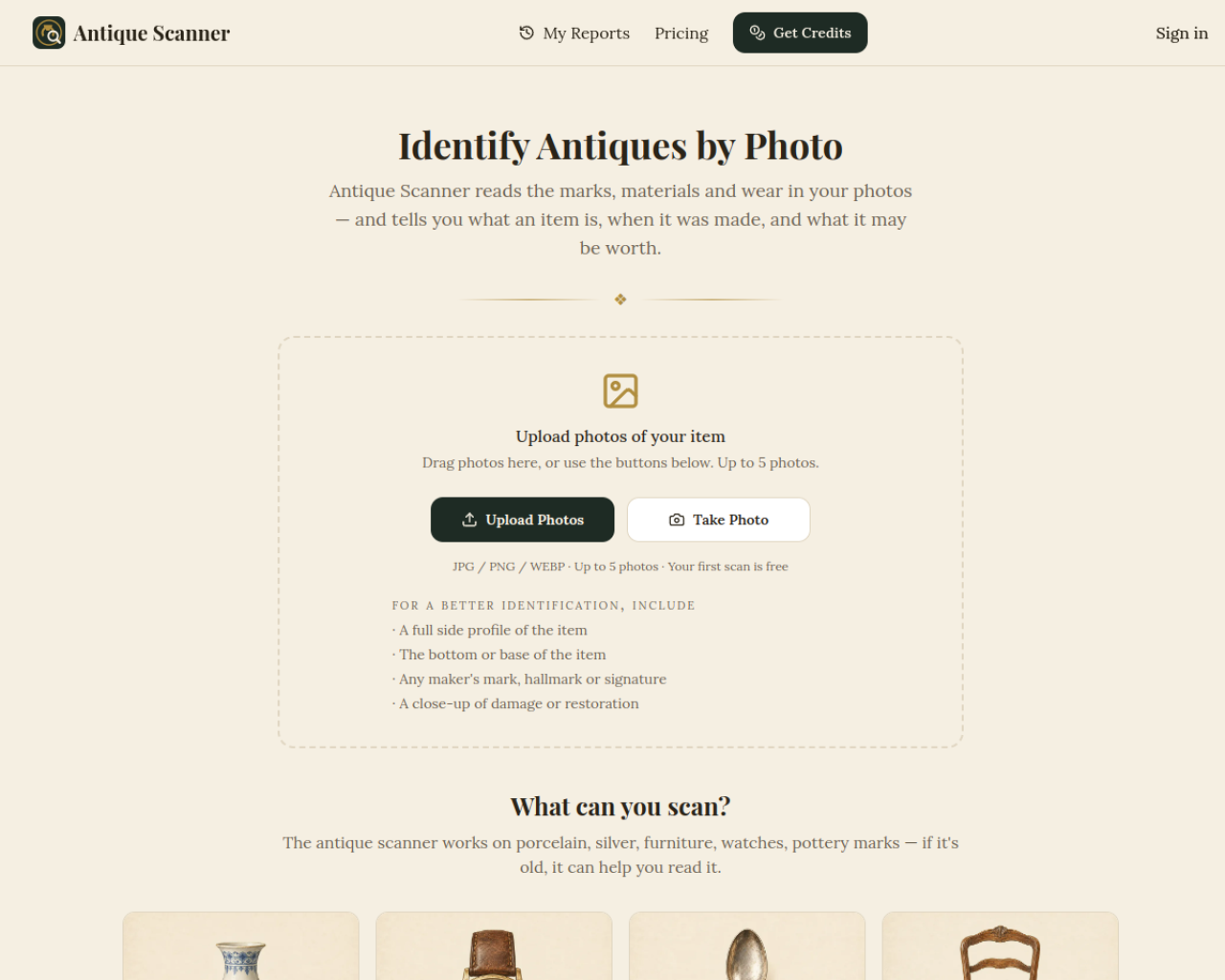
An antique scanner is a web-based AI tool that identifies old objects from photographs. Instead of matching images by visual similarity (the way a reverse image search does), Antique Scanner examines the details that appraisers actually trust — maker's marks, hallmarks, materials, construction techniques, and wear patterns — and produces a structured research report telling you:
- What the item probably is (maker, origin, materials, construction)
- When it was likely made (age estimate, often to the decade)
- What it may be worth (a three-tier value range, not one invented number)
The companion Antique Identifier page runs the same engine with a sharper focus on the identification step: naming that mystery item before you think about price.
The key idea: an antique never has one single "correct" price, and photo identification is never guaranteed. Antique Scanner is built to say what the evidence supports — and to tell you plainly when it doesn't support more. That honesty is the product's core differentiator in a market full of tools that confidently guess.
💡 Pro Tip
Marks are the strongest signal. A single sharp photo of the base or maker's mark can lift a finding from "Likely" to genuinely "Identified" — often more valuable than five photos of the pretty side.
What Can You Scan?
The antique scanner works on porcelain, silver, furniture, watches, pottery marks — if it's old, it can help you read it. Real examples from the site:
| Category | Example result from a scan |
|---|---|
| Porcelain vase | Hand-painted baluster vase — likely early 20th century, read from the base mark and paste. Market range $120–200. |
| Vintage watch | Mechanical dress watch, probable 1950s movement; serial range and dial fonts agreed. Redial flags: none. |
| Silver spoon | Sterling pattern identified from hallmarks — standard, maker, and date letter all read; date letter confirmed the assay year. |
| Antique chair | Ladder-back country chair with hand-cut joinery, 19th century; condition wear priced into the estimate. |
| Pottery mark | Impressed maker's mark matched to a pottery — the finding climbed from Likely to Identified on the mark alone. |
Beyond these, the tool handles glass, clocks, jewelry, paintings, books, tools, and most decorative objects — plus vintage and collectible items. It reads British hallmarks, continental factory marks, American art pottery, Asian ceramics, and more, wherever the photos carry readable form, materials, or marks. Reports are written in English whatever the item's origin.
The site also offers category-specific identifier pages with sharper guidance per material:
- Antique Pottery Identifier · Antique Porcelain Identifier
- Antique Silver Identifier · Antique Jewelry Identifier
- Antique Furniture Identifier · Antique Glass Identifier
- Antique Watch Identifier · Antique Vase Identifier
How Does Antique Scanner Work?
From photo to report in three steps:
- Upload 1–5 photos. Include a full side profile, the base, and any marks or signatures for the best results. Phone cameras are fine.
- AI analyzes the details. The engine examines form, materials, construction, marks, and wear, then estimates age and origin.
- Get your value report. A structured report with identification, confidence, evidence, and value ranges — saved to your private history.
graph TD
A[Upload 1–5 photos<br/>profile · base · marks · damage] --> B[AI reads marks, materials,<br/>construction, form & wear]
B --> C[Identification with<br/>confidence label]
C --> D[Three-tier value estimate<br/>quick sale · market · dealer]
D --> E[Report saved to history<br/>+ reshoot suggestions]
Most scans return in under two minutes once they run. Free scans sit in a short queue first; paid scans start instantly on a stronger model.
What's Inside an Antique Scanner Report?
Each report is a structured document with evidence, confidence levels, and honest uncertainties — not a paragraph of guesswork:
| Report section | What you get |
|---|---|
| Maker & mark analysis | Reading of maker's marks, hallmarks, and signatures — the details appraisers trust most |
| Three-tier value estimate | Quick sale, market, and dealer prices, because an antique never has one "correct" price |
| Confidence & evidence | Findings labeled Identified, Likely, Possible, or Uncertain, with evidence and open questions shown |
| Next-photos guidance | When a finding stalls, the report names the exact reshoot that would firm it up |
| Reproduction flags | Modern construction, inconsistent wear, wrong materials, or a mark style that postdates the piece — stated plainly under uncertainties |
The three-tier value estimate deserves explanation, because it mirrors how antiques actually trade:
| Tier | What it means |
|---|---|
| Quick sale | What you'd get selling fast — to a dealer, at auction without reserve, or on a short timeline |
| Market range | A realistic private-sale or well-marketed auction outcome |
| Dealer price | What a retail dealer would list it at — the price a buyer pays for the dealer's curation and guarantee |
✅ Best Practice
Scan one item at a time so marks and materials don't blend together. For sets like flatware or plates, scan the best-marked piece first — the identification usually covers the pattern, and value then scales by count.
Antique Scanner vs. Google Lens vs. Traditional Appraisal
| Antique Scanner | Google Lens / reverse image search | Professional appraiser | |
|---|---|---|---|
| What it does | Reads marks, materials & construction; explains reasoning; estimates value ranges | Finds images that look similar | Hands-on examination, certified documentation |
| Handles items unlike anything online | ✅ Yes — evidence-based, not similarity-based | ❌ Weak — needs visual matches | ✅ Yes |
| Value estimate | ✅ Three-tier range | ❌ No | ✅ Formal, certified |
| Confidence transparency | ✅ Every finding labeled with evidence | ❌ No reasoning shown | ✅ Expert judgment |
| Cost | First scan free; $3.98 per report after | Free | Typically $50–$150+ per hour |
| Speed | Under ~2 minutes | Seconds | Days to weeks |
| Best for | Research before decisions, mystery items, shelf finds | Orienting on well-documented items | Insurance, estate, tax, high-value items |
The honest framing: an AI report is a research estimate, not a certified appraisal. For insurance, estate, or tax purposes — or whenever an item may be worth more than $1,000 — use a professional appraiser. The report helps you decide whether that step is worth the fee.
How to Photograph Your Antique for the Best Results
Photo quality decides identification quality. The tool accepts up to 5 photos per scan (JPG / PNG / WEBP), and these four shots cover nearly every item:
| Photo | Why it matters |
|---|---|
| 1. Full side profile | Establishes form and silhouette — period fashion leaves fingerprints in shape |
| 2. Bottom / base | Where marks live; also reveals construction and wear honest to age |
| 3. Maker's mark, hallmark, or signature | The strongest single signal — can move a finding from Likely to Identified |
| 4. Close-up of damage or restoration | Condition gets priced into the estimate; hidden repairs get flagged |
⚠️ Note
Photograph worn punches and faint impressed marks in raking light (light from a low, sharp angle) so the marks cast small shadows. That one photo often settles the whole identification — and it's exactly what the pottery and silver identifier pages ask for first.
If evidence runs short, the report's next-photos section tells you the exact angle to reshoot rather than leaving you guessing.
Who Should Use an Antique Identifier?
Built for anyone who has ever held an old object and wondered:
- Collectors — research an unfamiliar piece before you buy, sell, or insure it.
- Thrifters & resellers — check what a shelf find might be worth before you pass it up — or before you pay too much for it.
- Estate & family — understand inherited items before dividing, selling, or keeping them.
Three typical moments to reach for the Antique Identifier:
- Mystery inherited items — put a name to the pieces in a relative's attic.
- Before you buy — check a dealer's or auction's attribution against what the object itself shows.
- After the flea market — identify a shelf find the same afternoon you carried it home.
No antiques knowledge is required: the photo tips cover everything, and the report explains its terms as it goes.
Pricing: What Does a Scan Cost?
Simple, one-time pricing — no subscription:
| Item | Price |
|---|---|
| First scan | Free (new accounts get credits for one full research report) |
| Full Antique Report | $3.98 — one-time payment, no subscription |
| Credit expiry | Never — credits don't expire |
| Failed scans | Refunded automatically |
For heavier use, see the site's pricing page and the Antique Value Checker page, which focuses on the valuation workflow.
Privacy is equally straightforward: photos are stored privately and never published. The analysis model receives short-lived, expiring links (typically 15 minutes), and you can delete your account and data at any time. Reports stay in your private history until you remove them.
How Accurate Is It? Honest Limits
Every finding carries an honest confidence label together with the evidence behind it and any open questions. Key limits to understand before you rely on a report:
- Visual similarity is never reported as a confirmed identification. A lookalike is a lead, not an answer.
- Paintings get partial treatment. The tool reads signatures, labels, and obvious style attributes, but attributing art to an artist needs an expert's eye and provenance. Treat painting results as orientation — a period, school, and condition read. (A "school of" finding means the piece was made in the manner and era of a maker, without direct evidence of that maker's hand.)
- No photo identification is guaranteed — and any tool that promises one is overselling.
- Reproductions get flagged, not ignored. Modern construction, inconsistent wear, wrong materials for the claimed period, or a mark style that postdates the piece are stated plainly under uncertainties.
⚠️ Note
For high-value decisions, treat the report as a research lead and confirm with a professional before committing money. Antique Scanner reports are AI research estimates, not certified appraisals.
🤔 Frequently Asked Questions (FAQ) {#faq}
Q: How is Antique Scanner different from Google Lens?
A: Google Lens finds images that look similar, which helps when you already know roughly what the item is. Antique Scanner goes further: it reads marks, materials, and construction, explains its reasoning, labels its confidence, and estimates value ranges for the item you actually photographed — including pieces that look like nothing in the search results.
Q: How accurate is the identification?
A: Every finding carries a confidence label — Identified, Likely, Possible, or Uncertain — with the evidence and open questions shown. Photos of marks and the base improve accuracy the most. When a finding stalls, the report names the exact reshoot that firms it up.
Q: Can it read pottery marks and silver hallmarks?
A: Yes — marks are the strongest signal the tool reads. Photograph the mark close-up in raking light so worn punches cast small shadows; that one photo often settles the whole identification. The pottery identifier and silver identifier pages carry the same guidance.
Q: Is this a real appraisal?
A: No. Reports are AI research estimates, not certified appraisals. For insurance, estate, or tax purposes — or whenever an item may be worth more than $1,000 — use a professional appraiser. The report helps you decide whether that step is worth the fee.
Q: Can the antique identifier tell if my item is a reproduction?
A: It flags the signs — modern construction, inconsistent wear, wrong materials for the claimed period, or a mark style that postdates the piece. Concerns are stated plainly under uncertainties rather than ignored.
Q: How many photos should I upload?
A: Up to five. Start with a full side profile, then add the bottom or base, any maker's mark or hallmark, and close-ups of damage or restoration. The base and mark shots usually matter most; five slots cover nearly every item.
Q: What does a scan cost?
A: Your first scan is free. After that, a Full Antique Report is $3.98 — one-time payment, no subscription. Credits never expire, and failed scans are refunded automatically.
Q: How long does an identification take?
A: Most scans return in under two minutes once they run. Free scans sit in a short queue first; paid scans start instantly on a stronger model.
Q: What happens to my photos?
A: They're stored privately and never published. The analysis model receives short-lived, expiring links — typically 15 minutes — and you can delete your account and data at any time.
Q: Does it work for items from any country?
A: Yes. The scanner reads British hallmarks, continental factory marks, American art pottery, Asian ceramics, and more — wherever the photos carry readable form, materials, or marks. Reports are written in English whatever the item's origin.
Q: Can one scan cover a set of items?
A: No — scan one item at a time so marks and materials don't blend together. For sets like flatware or plates, scan the best-marked piece first: the identification usually covers the pattern, and value scales by count.
Conclusion & Next Steps {#conclusion}
If you're holding an old object and wondering what it is and what it's worth, Antique Scanner is the most honest first step available online: it reads the marks, materials, and wear in your photos; labels every finding with confidence and evidence; and gives you a three-tier value range instead of a single invented number — with your first scan free and full reports at a one-time $3.98.
Recommended next steps:
- Start with the Antique Identifier to name a mystery item, or the homepage scanner for the full identify-and-value workflow.
- Photograph deliberately: full profile, base, marks, damage — in raking light for worn punches.
- Let the report's confidence labels guide you: act on Identified findings, keep researching Possible ones with the suggested reshoots.
- Escalate when it matters: for insurance, estate, tax, or items possibly worth over $1,000, take the report to a professional appraiser — it makes that conversation faster and cheaper.
Related resources:
- Antique Scanner — homepage tool
- Antique Identifier · Antique Value Checker · Identify Antiques by Photo · Antique Appraisal Online
- Category pages: pottery · porcelain · silver · furniture · glass · watches · vases · jewelry
Disclaimer: This article is based on publicly available content from antiquescanner.org, last verified on September 19, 2026. Prices and features are subject to the live site. AI identification results are research estimates and do not constitute a certified appraisal.