Updated November 15, 2026
The throwing disc is an announced Minecraft ranged weapon that flies back after you throw it. Mojang has scheduled it for the first game drop of 2027. Official announcement
For anyone searching for “throwing disc minecraft,” the useful starting point is its flight behavior. A weapon that returns raises different questions from one that simply sends a projectile toward a target: where should you stand, what should you aim through, and can the room help your shot?
This guide explains the confirmed design, links to the official reveal video, and separates practical ideas from details that still need a playable release.
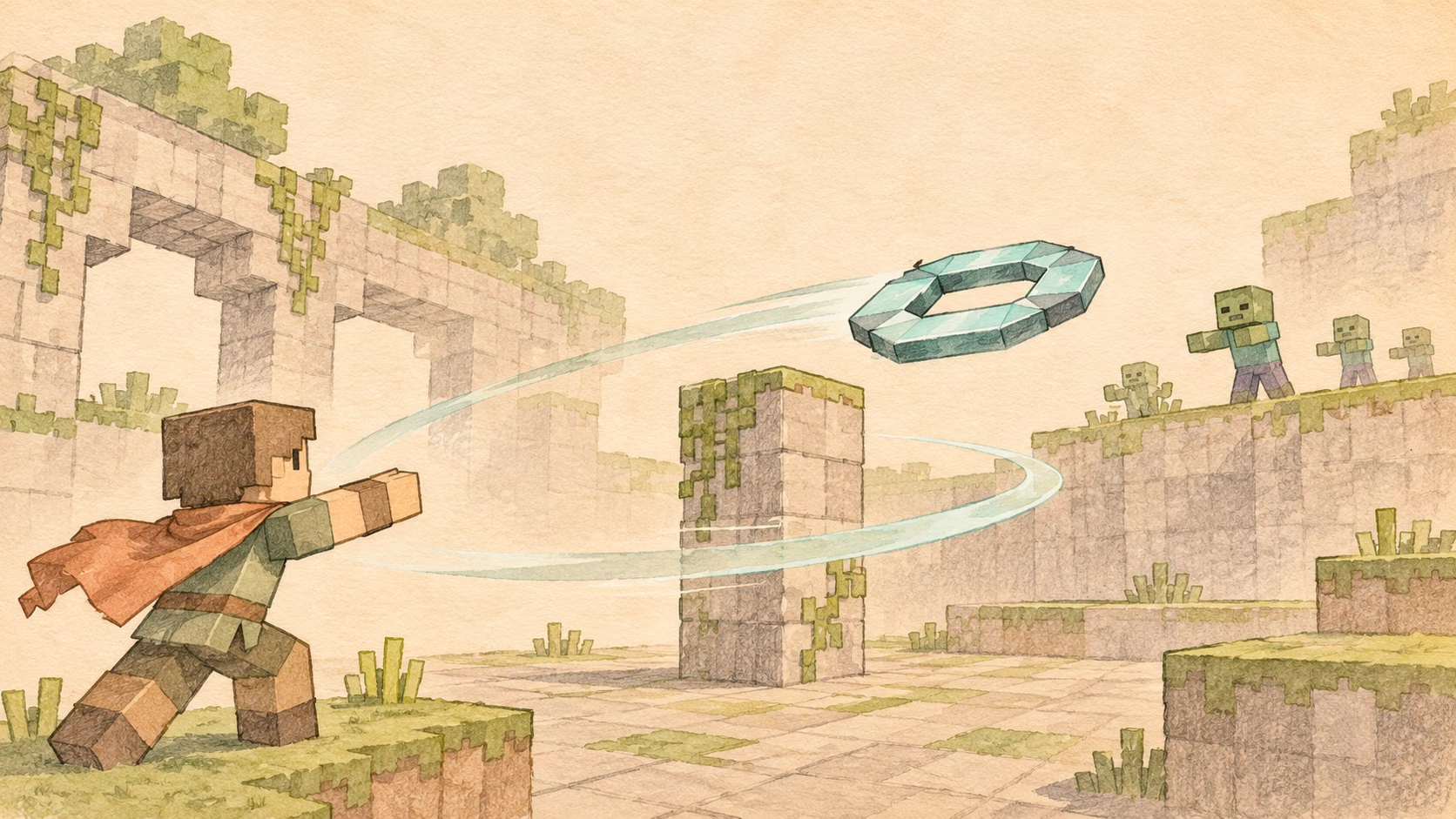
Illustrations are AI-generated concept art, not gameplay screenshots or exact flight-path diagrams.
1. What has Mojang confirmed?
The announcement describes three connected mechanics: the disc returns to its thrower, passes through enemies lined up along its trajectory, and ricochets off hard surfaces. Its direct range is limited, while bouncing can let it travel farther. Mojang’s weapon overview
Think of a practice throw in a small courtyard. With a direct shot, you consider the space between yourself and the target. Add a rebound, and the nearby wall becomes another part of the problem.
That is the interesting design idea here. The question expands from “Can I aim at this mob?” to “Can I find a useful route through this space?” How much that matters in actual combat will depend on the final tuning.
2. Watch the official throwing disc video
Start with NEW THROWING WEAPON ALERT! — Minecraft on YouTube. This is a 21-second reveal on Minecraft’s verified official channel.
The clip is a useful visual companion to the written announcement. When watching, focus on the projectile’s movement rather than trying to estimate damage from a short demonstration.
For the release context and official images, open TwitchCon reveals the first game drop features of 2027 alongside it.
A reveal answers “What kind of weapon is this?” A playable build and its changelog are the better places to answer “Exactly how does it work?”
3. How to think about its combat mechanics
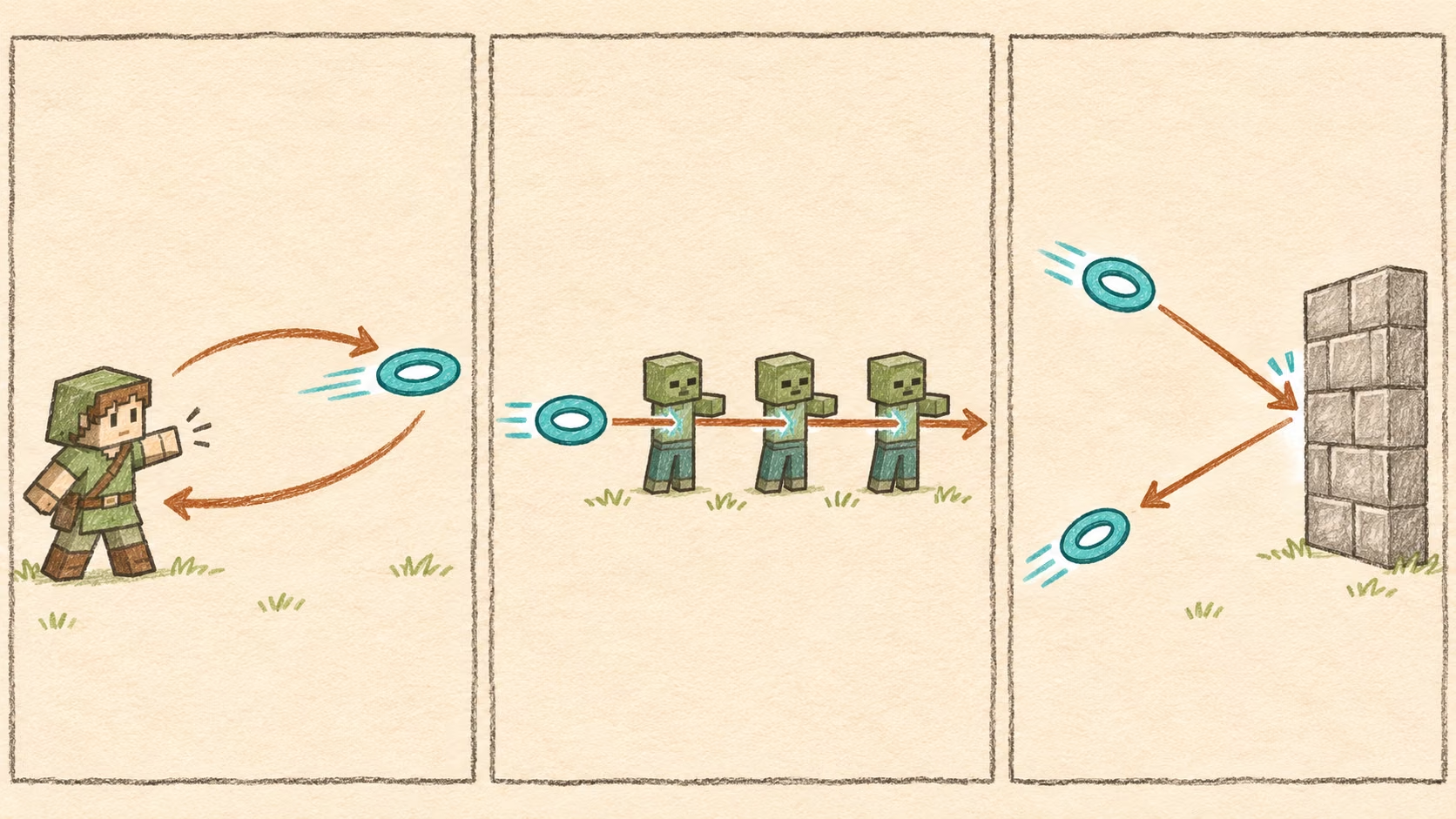
Each property suggests a different thing to learn. The following are ways to approach future testing, rather than tested combat instructions.
The return makes timing worth testing
An early experiment should be simple: throw once, watch the full trip, and try again only after the weapon comes back.
The useful measurement is the complete attack cycle. A dramatic hit tells you little about sustained combat if you do not also know how soon the next useful throw becomes possible.
Questions to test include whether another throw can begin immediately after catching the disc and how moving during its flight affects the rhythm. The announcement alone does not settle those interactions.
Passing through enemies makes positioning worth testing
Imagine several approaching mobs spread across an open area. Compare that situation with the same number arranged along a narrow approach.
The announced pass-through behavior suggests that alignment could matter. A sensible experiment would compare a scattered group with a line, while keeping the disc material and other conditions the same.
This is a reason to investigate crowd control. It is too early to turn it into a claim about the best weapon for a mob farm or a particular encounter.
Ricochets make the surroundings worth testing
A rebound introduces another aiming decision: which surface should the projectile meet, and at what angle?
Begin with one unobstructed wall. Observe a single bounce before attempting a complicated route between pillars. A simple setup makes it easier to distinguish a repeatable shot from a lucky one.
The exact eligible surfaces, bounce limits, and flight rules need their own verification. Treat the illustration as a guide to the concept, not a specification for building an arena.
4. Materials and crafting
Mojang lists five materials: copper, iron, gold, diamond, and netherite. The reveal article does not provide a crafting-grid recipe or a numerical comparison between them. Official material list
A material name is not enough to reconstruct a recipe. It also does not establish which version offers the best balance of damage, durability, and cost.
If your immediate goal is to craft a throwing disc, wait for instructions tied to an identified game build. A useful recipe guide should show the ingredients, their arrangement, and the edition and version in which the recipe works.
The same standard applies to commands. An item identifier guessed from the display name is not a verified /give command.
5. Why Bedrock off-hand support matters
The same announcement schedules broader off-hand support for Bedrock and shows the disc being held in either hand. Official off-hand announcement
For players, that creates a practical control question: how will throwing fit around the item in the other hand?
When testing becomes available, try the simplest setup first. Check the relevant input with an empty opposite hand, then repeat with another item equipped. This should make any interaction easier to understand.
Holding an item and activating it are separate questions. A screenshot of a two-item loadout does not establish every possible combination of actions.
6. What still needs an answer?
The reveal leaves several decisions open for anyone planning a survival loadout or a server minigame.
| Question | Why the answer matters |
|---|---|
| What are the damage and attack-cycle values? | They determine how the disc performs over several attacks. |
| How does each material behave? | Players need a reason to choose one version over another. |
| What counts as a hard surface? | Builders need predictable rebounds. |
| Which enchantments, if any, apply? | These could change how players equip the weapon. |
| What happens during unusual returns? | Movement, obstacles, and multiplayer situations need testing. |
These are questions to carry into testing, not gaps to fill with assumed numbers. In particular, a returning projectile does not by itself prove that its return journey deals damage.
7. A useful first test when it becomes playable
Build a small, open practice area with one wall and enough room to observe the projectile. Start with a single disc material.
First, make a clear throw without a target. Next, try a single target. Then compare aligned targets with separated targets. Finally, introduce one wall rebound.
Change one condition at a time and record the game version. That gives you observations you can compare, especially if later builds adjust the weapon.
The throwing disc’s appeal is easy to understand: aiming may involve both the enemies and the space around them. The official reveal gives us that design direction. The next useful step is to see how consistently players can turn it into deliberate, repeatable throws.
Sources and video
- Minecraft.net — TwitchCon reveals the first game drop features of 2027, published November 14, 2026. Primary source for the announced mechanics, materials, release window, and Bedrock off-hand feature.
- Minecraft on YouTube — NEW THROWING WEAPON ALERT!. Official 21-second reveal video.
This article covers the announcement as checked on November 15, 2026. Its testing suggestions are proposed experiments, not results from hands-on play.