Decisions API Official Website
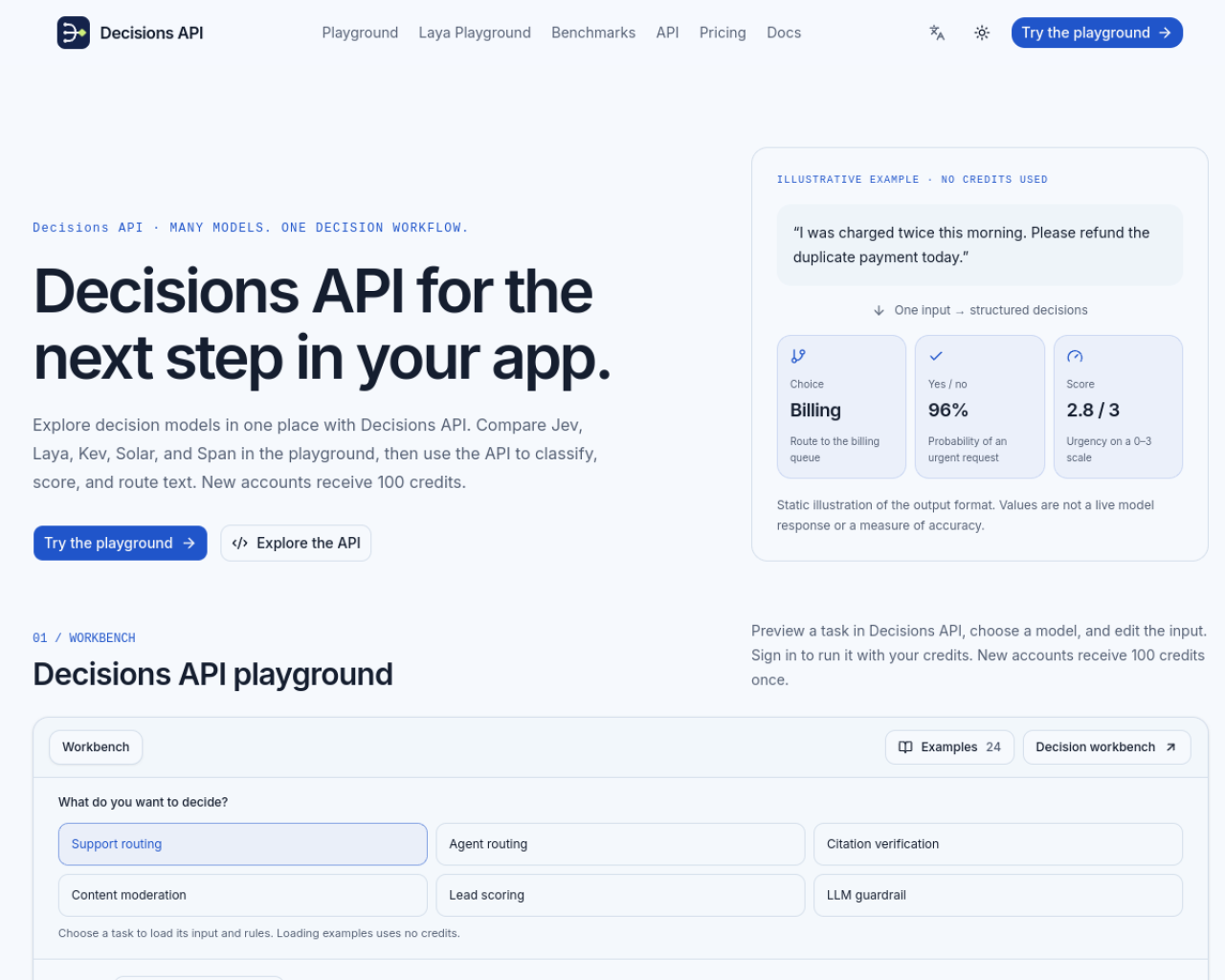
Decisions API (decisions-api.org) is an independent developer platform that brings multiple "decision models" — Jev, Laya, Kev, Solar Decide, and Span — into one playground and one unified API for classifying, scoring, and routing text.
- Official app: https://decisions-api.org (also available in German at /de and Chinese at /zh)
- Creator: Not publicly named; the site describes itself as an independent platform and is not affiliated with OpenAI
- Price: 100 free welcome credits on sign-up; paid credit packs $10 / $100 / $1,000 — one-time, no subscription, credits never expire
- Login required: Yes for the playground and API keys (Bearer-token auth; Google One Tap sign-in available)
- Platform: Web (Next.js app) + REST API at
POST /v1/systemone - Main use: Turning text into typed decisions — a label (Choice), a rating (Score), or a yes/no with probability (Noul) — for support routing, agent steps, and claim checks
- Last checked: September 30, 2026
We are not the official developer of Decisions API. This page helps users find, understand, and use the product.
What Is Decisions API?
"Decisions API" is a term with two meanings right now, and this page resolves both. On September 29, 2026, OpenAI DevDay coverage described an OpenAI Decisions API entering limited preview — bounded decisions from text or image context on a specialized GPT-6 Luna version, with a reported ~150 ms demo response. The site at decisions-api.org is not that product: it's an independent platform launched into exactly that conversation, which aggregates third-party decision models behind one shared endpoint and lets you compare them before wiring one into your app.
The pitch: "Many models. One decision workflow." Instead of prompting an LLM and parsing prose, you send a state (a ticket, a message, a record, JSON) plus structured questions, and get back typed answers with probability signals:
- Choice — one label from a defined set, each option described in plain language ("billing: payments, charges and refunds"), with the full probability distribution so you can see when two options overlap.
- Score — a rating along a rubric you define (urgency 0–3, relevance levels), making inputs comparable without open-ended opinions.
- Noul — a yes/no judgment with a yes-probability threshold, e.g. whether a cited passage actually supports a claim.
The models currently offered in Decisions API, with their real identifiers: typesafe/jev-1.13 (the Jev decision model, which also documents Choice/Noul/Score on its own site), upstage/solar-decide, jaredpalmer/kev-4b, laya-english, laya-multilingual, and laya-auto, plus Span-01 and Span-01 Lite. Each has its own input limits and credit rate — Span-01 is the cheapest at scale, Span-01 Lite is a flat 1 credit per request.
Beyond the playground, the most substantive feature is the evaluation workbench: run configuration A against configuration B on the same cases (up to 25 per comparison), add expected answers, inspect individual failures, and export the report — a proper A/B harness for decision quality rather than vibes.
How to Use Decisions API
- Open decisions-api.org and sign in (new accounts receive 100 credits once — enough for roughly 100 short requests).
- Try a recipe in the playground: customer-request routing, agent next-step selection, or claim-versus-evidence checking. Edit the sample state and the question criteria.
- Compare two models or two question phrasings on the same cases in the evaluation workbench; read probabilities, not just winning labels.
- Create an API key and copy the generated cURL, JavaScript, or Python example — the shared endpoint keeps the integration identical across models:
const response = await fetch("https://decisions-api.org/v1/systemone", {
  method: "POST",
  headers: { "Authorization": `Bearer ${process.env.JEV_API_KEY}`,
             "Content-Type": "application/json" },
  body: JSON.stringify({
    "model": "typesafe/jev-1.13",
    "state": "I was charged twice for order A-4471.",
    "questions": { "route": { "type": "choice",
      "criteria": { "billing": "Payments, charges and refunds",
                    "technical": "Bugs and product errors",
                    "account": "Login and account access",
                    "other": "None of these teams" } } }
  }),
});
- Wire the typed answer into your routing or escalation rules — the platform produces the decision signal; your application owns what happens next.
Is Decisions API Safe?
For a developer evaluating it, the verifiable facts cut both ways:
- Favorable billing design: one-time credit packs with no subscription and no auto-renewal, credits that never expire, budget reserved before each call, failed calls refunded, and output tokens not charged. This is close to the least-lock-in pricing structure an API service can offer.
- Standard auth posture: server-side Bearer tokens, request identifiers for troubleshooting, API usage records kept as metadata without storing full request bodies (private web history does store states and answers for revisit — don't paste secrets into the playground).
- Clearly labeled honesty: the site explicitly flags its homepage example as an illustration, states that probability is "not measured accuracy," and distinguishes official evidence from preview reporting in its OpenAI comparison — an unusually careful tone for a launch-week site.
- The real caveat — it's brand new. The decisions-api.org domain was registered on September 30, 2026, essentially the day this platform launched. There is no track record, no published company identity, and no third-party reviews yet. Treat it as an experiment: use the free credits first, keep the API key scoped to non-critical workloads, and don't route consequential decisions through it until it has a history.
Why Is Decisions API Popular?
The timing explains the attention. OpenAI's Sept 29 DevDay made "Decisions API" a category keyword overnight, and this site launched the next day into that search demand — complete with a maintained "OpenAI Decisions API vs Jev" comparison page that separates official facts from preview reporting. Underneath the news cycle, the underlying need is real: agent and SaaS workflows increasingly need thousands of cheap, typed micro-decisions (route, escalate, approve) where a full LLM call is slow and unstructured, and decision-model services like Jev have been building this category. Decisions API aggregates that emerging model market the way comparison playgrounds aggregate LLMs.
Decisions API appears to be gaining attention through the OpenAI DevDay news cycle and developer communities tracking decision models; there is no clear public source showing where its traffic originated.
Decisions API Not Working?
- Refresh the page — the playground is a client-heavy app and occasionally needs a reload.
- If a request fails with an auth error, check that your API key is set server-side (never in browser code) and uses the Bearer scheme.
- Insufficient credits: welcome credits are granted once; check the credit history in your account area, which separates web from API usage.
- Wrong-looking answers: check whether the input contains the evidence your criteria require, and whether the model suits your language — the Laya family includes English, multilingual, and auto variants.
- Site unreachable during launch week: as a newly deployed service it may be updating; try again later.
Decisions API was online and serving the playground as of September 30, 2026.
Decisions API Alternatives
- Jev (jevaimodel.net) — the original decision-model API behind one of the aggregated models: its own playground, SDK, and one-time credit pricing.
- OpenAI Decisions API — the official limited-preview product from OpenAI (GPT-6 Luna based); not available on decisions-api.org, and access is currently restricted.
- LLM structured outputs (JSON mode / function calling) — the DIY route on any frontier model: flexible but slower, pricier per decision, and you own schema validation.
Frequently Asked Questions
What is the official Decisions API website?
The official website of this independent platform is https://decisions-api.org. Note that OpenAI also announced a product called "Decisions API" in limited preview on September 29, 2026 — that official OpenAI product is separate and not served by this site.
Is Decisions API free?
You get 100 credits free on sign-up (a short request costs about 1 credit). Beyond that, packs are $10 (100,000 credits), $100 (1,000,000), or $1,000 (10,000,000) — one-time purchases, no subscription, credits never expire, failed calls refunded.
Do I need an account to use Decisions API?
Yes — sign-in is required to run the playground with credits and to manage API keys (Google One Tap sign-in is available).
Who created Decisions API?
The operator is not publicly named. The site presents itself as an independent platform for decision models and explicitly states it is not OpenAI's official product.
Is Decisions API still available?
Yes — as of September 30, 2026 the site, playground, pricing, and API docs are live, with EN/DE/ZH versions. The domain is newly registered (September 30, 2026), so availability history is short by definition.